

Thursday, April 30, 2026

MinDA strengthens economic ties with EFTA, eyes Norway-led collaboration in fisheries and renewable energy

The Mindanao Development Authority (MinDA) has reaffirmed its commitment to expanding economic cooperation with the European Free Trade Association (EFTA), highlighting strong opportunities for collaboration with Norway in fisheries, aquaculture, and renewable energy as Mindanao advances its role as a key growth corridor for trade, investment, and sustainable development.

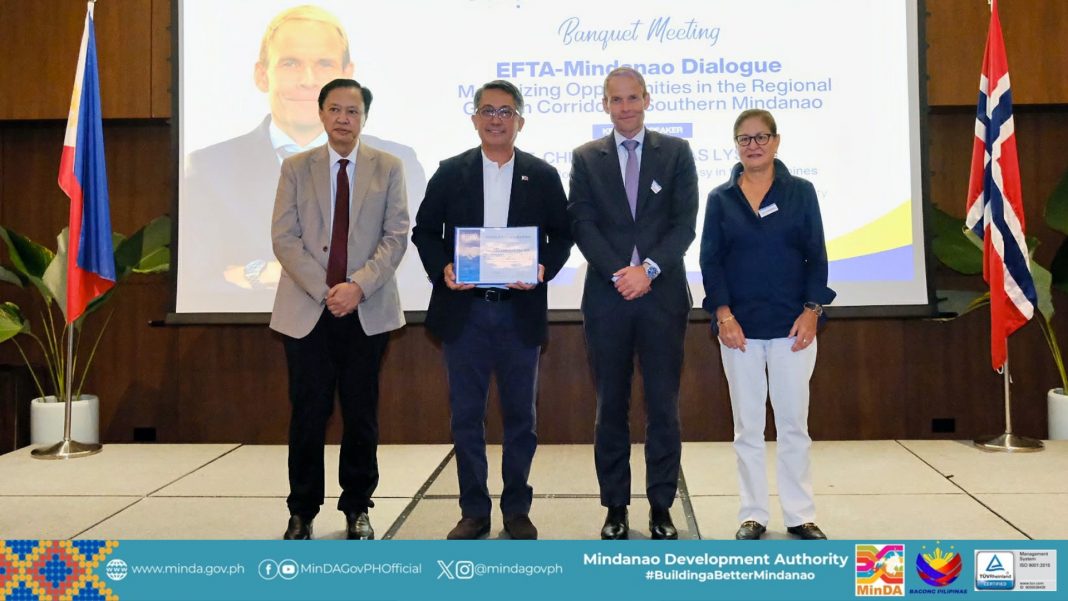
During the EFTA–Mindanao Dialogue in Davao City, MinDA Secretary Leo Tereso A. Magno emphasized the growing alignment between Mindanao’s development priorities and the technical and investment strengths of EFTA member states.

“The economic alignment between Mindanao and EFTA member states is not only evident—it is increasingly actionable, strategic, and results-driven,” Magno said.

MinDA underscored that Mindanao’s priorities in renewable energy, agri-industrial value chains, and digital and logistics connectivity closely match EFTA’s expertise in green technology, maritime industries, sustainable finance, and innovation-driven sectors.

A key highlight of the dialogue was Norway’s global leadership in sustainable fisheries and aquaculture. MinDA identified major coastal production areas—including General Santos, Zamboanga, Davao Oriental, and the Surigao Strait—as prime locations for collaboration. These regions offer strong potential for investments in maritime systems, cold chain infrastructure, and seafood processing, aligning with Norwegian capabilities.


Renewable energy also emerged as a priority area for cooperation. MinDA pointed to Mindanao’s significant potential in wind, hydro, solar, and hybrid energy systems, as well as opportunities for technology transfer and green financing amid increasing global interest from Norwegian firms in clean energy transitions.

Trade relations between the Philippines and EFTA are anchored on the Philippines–EFTA Free Trade Agreement framework, which supports expanded market access, investment flows, and economic integration. According to the Department of Trade and Industry (DTI), Switzerland and Norway remain among the Philippines’ key European partners, despite relatively modest overall trade volumes.

Philippine exports to Europe—including EFTA markets—are largely driven by agricultural and fisheries products, electronics, and manufactured goods, while imports consist mainly of machinery, pharmaceuticals, and high-value industrial inputs, based on data from the Philippine Statistics Authority (PSA).

Mindanao plays a critical role in this trade landscape, particularly as a major source of agricultural and fisheries exports such as tuna. These exports benefit from the European Union’s Generalized Scheme of Preferences Plus (GSP+), which enhances the competitiveness of Philippine goods in European markets.

“Southern Mindanao is ready to take the next step,” Magno said. “With projected growth of 6–7 percent, the region is open for EFTA-scale investments that are both competitive and sustainable. These engagements allow us to translate partnerships into jobs, innovation, and inclusive growth.”

The initiative aligns with President Ferdinand R. Marcos Jr.’s push to diversify trade partnerships and strengthen economic ties with non-traditional markets. It also supports the administration’s broader agenda of accelerating the energy transition and promoting sustainable investments under the Philippine Development Plan 2023–2028.

The dialogue brought together key stakeholders from government and the private sector, including representatives from the Royal Norwegian Embassy in Manila, the Department of Trade and Industry Region 11, the Davao City Investment and Promotion Center, and the European Chamber of Commerce of the Philippines.

MinDA reaffirmed its readiness to work closely with EFTA member states, the European Union, and domestic partners to fully harness Mindanao’s natural and economic strengths.

“Stronger international partnerships will be key to advancing Mindanao’s role in global value chains, accelerating rural development, and supporting the country’s broader economic transformation,” Magno added.

- Advertisement -spot_img
spot_img

LATEST

- Advertisement -spot_img