


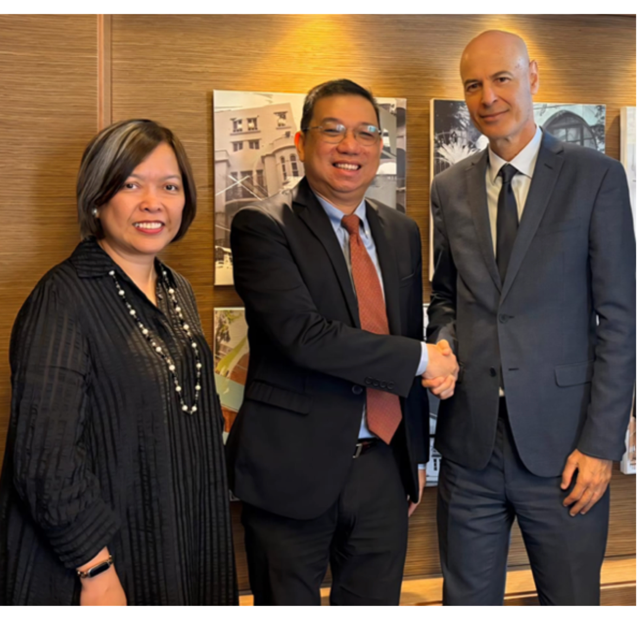
Philippines and Israel are forging strategic bilateral cooperation on critical minerals processing and AI technology ecosystem, in connection with the US-led Pax Silica initiative and critical minerals frameworks.
Trade and Industry (DTI) Undersecretary and Board of Investments (BOI) Managing Head Dr. Ceferino Rodolfo met with Israeli Ministry of Foreign Affairs Director General Eden Bar Tal on May 1, 2026 in Tel Aviv to discuss the strategic cooperation. Rodolfo was in the region to participate in the Organization for Economic Cooperation and Development (OECD) critical minerals forum and visit countries included in the Pax Silica alliance.
During the meeting, both officials also explored a possible bilateral MOU on critical minerals cooperation, including mineral processing, research and development, and ways to leverage the Philippines’ semiconductor and microchip manufacturing sector to support AI development, highlighting the strong complementarity between Philippine mineral resources and skilled workforce and Israeli technology and innovation.
Director General Bar Tal chairs the governmental steering committee tasked with developing Israel’s national strategy on critical minerals.
Both sides discussed how Israel’s advanced mining, water, and environmental technologies can help strengthen the Philippines’ processing and refining of key minerals such as nickel, copper, and cobalt, helping the country move up the value chain and build higher-value industries and products.
“Our strategic goal has been to add more value to our green metal exports—for example, nickel (which also comes with cobalt) and copper (which comes with gold), as we have historically exported these minerals in largely unprocessed form,” said Rodolfo.
He explained that green metals as called as such for the manner by which they are extracted and processed conform with global sustainability standards (e.g. on impact to the environment and upholding labor rights); and the crucial role they play in enabling shift to new energy solutions (e.g. they are key materials for batteries, for energy storage systems, for electric vehicles).
Strategic goal
Rodolfo stressed that access to latest AI technology, especially to tech which are relevant for the manufacture of key components of compute hardware infrastructure, is an “opportunity for the Philippines to elevate or to add another layer to our ambition for our green metals—-we can now aspire towards local value-addition for our green tech-metals.”
In this context, he said, “partnership with Israel is critical as they are a recognized global leader in 2 key technologies: water system management for industrial tech applications and innovations in AI compute hardware manufacturing.”
Critical minerals are essential to the semiconductor supply chain, providing the raw materials needed for microchips, advanced processors, and other hardware that power AI systems.
While in Israel, Rodolfo also met officials from Israel’s Trade Ministry, the Israel National AI Directorate, the Israel Innovation Authority, and key partners in Israel’s trade and high-tech sectors.
The discussion with Israel on critical metals cooperation followed the Philippines’ recent accession to the Pax Silica alliance and the announcement of a partnership with the United States to establish a 4,000-acre AI-native industrial acceleration hub in Luzon.
Israel is a founding member of Pax Silica, a U.S.-led international initiative launched in December 2025 to create a secure, trusted supply chains for AI, semiconductors, and critical minerals. It involves 13+ countries, including the Philippines, to reduce dependency on high-risk, non-allied nations by fostering allied-based manufacturing and mineral processing.

