


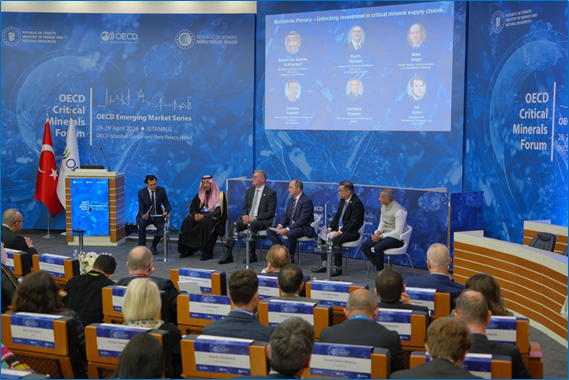
The Philippines was invited to the High-Level Ministerial Panel on “Unlocking Investment in Critical Mineral Supply Chains”. Dr. Ceferino S. Rodolfo, Department of Trade and Industry (DTI) Undersecretary and Board of Investments (BOI) Managing Head, represented the Philippines in the panel session, alongside Bandar bin Ibrahim Al-Khorayef, Minister of Industry and Mineral Resources, Kingdom of Saudi Arabia; Karim Badawi, Minister of Petroleum and Mineral Resources, Arab Republic of Egypt; Mike Kopp, Senior Advisor to the Secretary of the U.S. Department of Energy; and Rohitesh Dhawan, CEO, International Council on Mining and Metals.
The High-Level Ministerial Panel, the main panel of the OECD Critical Minerals Forum, focused on the intensifying global demand for critical mineral, emerging new opportunities and risks across supply chains, concentration of production and processing in a handful of countries, and far-reaching consequences of disruptions and geopolitical tensions on energy security and economic stability worldwide. The session was rich in dialogue on diversifying supplies, capturing greater value from countries’ resources, and ensuring that supply chains support is sustainable, inclusive, and resilient.
Spotlight was given to the Philippines owing to it being the world’s second-largest nickel producer.
The Philippines is emerging as a critical source of nickel, especially at a time when resource resilience and supply chain diversification have become paramount concerns for the global economy. The country is actively working to expand its production processing and refining capabilities, while aligning its regulatory environment with international standards to attract high-quality, sustainable investment. As global partners increasingly prioritize secure and diversified critical mineral supply chains, the Philippines represents a strategic opportunity to build resilient, responsible partnerships that deliver broad economic and social benefits.
To leverage its position as a leading nickel supplier and to enable strategic international partnerships, the country has adopted and is continuously working on frameworks and mechanisms for cooperation. Undersecretary Rodolfo delivered a remarkable statement about the country’s strategy to achieve its critical mineral goals – the three Ps” towards the fourth “P”.
First, Policy: to ensure that domestic policy is in place – for example, the passage of the “Enhanced Fiscal Regime for Large-Scale Metallic Mining Act”, which includes provisions aimed at equitable returns (both in terms of sharing and timing), fiscal transparency, and sustainable development.
Second, Permitting: With a standing proposal to reduce significantly the permitting process from 11 years to 11 months – and doing so without cutting corners, but making sure that all environment, labor, and other important standards are complied with.
Third, Partnership: The Philippines is choosing partnership instead of prohibition – partnership in the domestic setting, between government and private sector, and equally important, international partnerships.
And fourth, the first three leading to (bankable) Processing Projects: Citing a recent milestone project with the United States, the AI Native Industrial Acceleration Hub, which will be housed in a 4,000-acre land in New Clark City, which will support and accelerate energy and AI transition – overall supporting the ambitious agenda of the Philippines without neglecting its promise for greater sustainability.

