


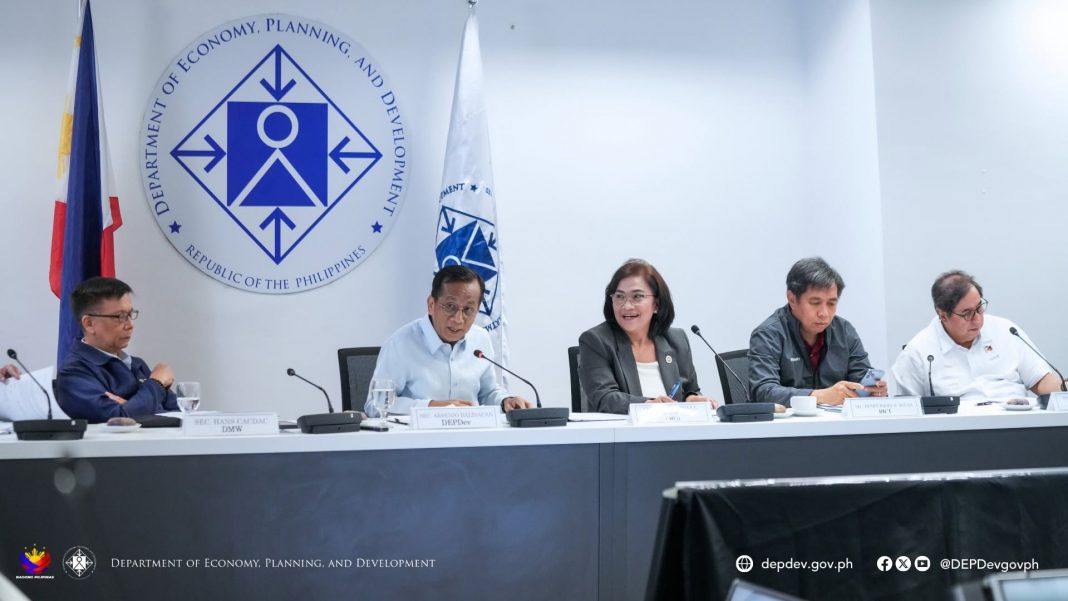
Department of Economy, Planning, and Development (DEPDev) Secretary Arsenio M. Balisacan convened the Social Development Committee-Cabinet Level (SDC-CL) on Thursday, June 4, to fast-track critical government initiatives targeting public health preparedness, digital healthcare access, and resilient education reforms.
The meeting focused on leveraging data and digital technology to strengthen the country’s human development outcomes and protect vulnerable sectors from future crises.
A central focus of the high-level meeting was fortifying the nation’s health systems against future public health emergencies. The University of the Philippines Manila – National Institutes of Health (UPM-NIH) briefed the Committee on its updated Pandemic Response Playbook. The playbook emphasizes institutionalizing evidence-based approaches and integrating lessons learned from past pandemics into the country’s current response architecture.
To improve social safety nets, the Department of Health (DOH) presented a major digital milestone for the Medical Assistance to Indigent and Financially Incapacitated Patients (MAIFIP) Program. The newly rolled-out eMAIFIP system, integrated directly into the government’s eGovPH App, aims to streamline medical assistance applications, expand healthcare access, and significantly reduce out-of-pocket medical expenses for low-income families.
The Committee also addressed key demographic shifts and safety protocols:
-
Demographic Strategies: The Philippine Statistics Authority (PSA) and the Commission on Population and Development (CPD) presented the policy implications of the 2025 National Demographic and Health Survey (NDHS). The discussion highlighted how population dynamics directly influence gender equality, poverty reduction, and long-term human capital development.
-
Disaster Response in Education: In response to increasing environmental challenges, the Committee reviewed proposed directives from the Department of Education (DepEd) regarding the suspension of classes and government work during natural or human-induced hazards, aiming to standardize safety protocols nationwide.
Underscoring the administration’s “whole-of-government” approach, the meeting brought together key cabinet members and agency heads, including DOH Secretary Teodoro J. Herbosa, Commission on Higher Education (CHED) Chair Shirley M. Agrupis, Department of Migrant Workers (DMW) Secretary Hans Leo J. Cacdac, and Department of Information and Communications Technology (DICT) Secretary Henry Rhoel R. Aguda.
Senior officials from the Office of the Executive Secretary (OES), Department of Social Welfare and Development (DSWD), Department of Labor and Employment (DOLE), National Anti-Poverty Commission (NAPC), Department of Agriculture (DA), Department of the Interior and Local Government (DILG), and the Department of Budget and Management (DBM) were also in attendance to align their respective agency policies with the committee’s socio-economic goals.

