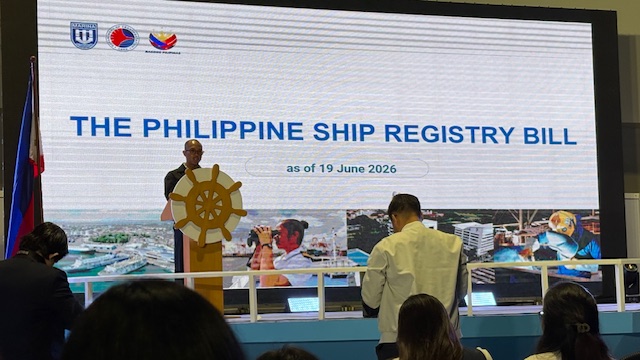
MARINA pushes ship registry, incentives bills to position PH as competitive global flag state
The Maritime Industry Authority (MARINA) is seeking congressional support for two proposed measures—the Philippine International Ship Registration Bill and the Philippine International Shipping Fiscal Incentives Bill—aimed at positioning the Philippines as a competitive and credible international ship registry while attracting foreign tonnage investments while maintaining robust regulatory oversight.
In a presentation at the 11th PhilMarine 2026 on the topic “Beyond the Sea: Connecting Philippine Shipping to the World through Global Partnerships”, MARINA’s Raymond Villaflor said the twin bills emerged from a redrafting of the original Ship Registry Bill authored by Rep. Angelo Marcos Barba during its initial congressional campaign last year. The measure was later split into two complementary bills—one covering the registration of international ships and the other focusing on fiscal incentives for registered vessels. Rep. Nathaniel Otocado is now the champion for the bill’s passage.
In an interview following his presentation, Villaflor said only 99 ships are currently registered under the Philippine flag. MARINA aims to increase the registry by 20 to 25 percent by 2028 by attracting vessels currently registered under other flags, he said.
During the 1990s, more than 400 ships were registered under the Philippine flag, he noted. However, the country’s registry gradually lost its attractiveness due to high registration costs, lengthy processing times, and other factors.
Once enacted, he said, the measures are expected to make the Philippine registry more cost-competitive and attractive through a new package of incentives. The planned digitalization of the registration system would also reduce processing time to as little as one day, bringing it in line with leading international registries.
Philippine International Ship Registration Bill
The proposed ship registration bill seeks to establish an electronic registration system that is fast, modern, and reliable, making registration more responsive and accessible to prospective registrants.
A key provision allows 100 percent foreign equity in shipping enterprises registered under the measure, building on the liberalization introduced under Republic Act No. 11659, which amended the Public Service Act. Previously, vessels had to be at least 60 percent owned by a Filipino company to qualify for registration.
“This provision signals the Philippines’ openness to foreign investment in the maritime sector and removes a long-standing barrier that had limited the registry’s competitiveness against established open registries,” he said.
The bill also introduces more flexible crew nationality rules, allowing management-level positions to be held by foreign nationals. Villaflor said the provision recognizes the realities of international shipping, where ownership and management structures are often multinational, while preserving employment opportunities for Filipino seafarers in operational roles.
Another provision simplifies bareboat chartering arrangements by streamlining legal and administrative requirements for charter-by-demise transactions. This is expected to make the registry more attractive to vessels already financed or managed under international leasing and charter agreements.
The bill likewise standardizes the legal framework governing maritime liens, ship mortgages, and liability limits, providing greater legal certainty and predictability for financiers, lenders, and ship operators. According to Villaflor, aligning with international commercial norms is critical to ensuring Philippine-registered vessels remain financially bankable.
Finally, the measure strengthens compliance and safety oversight, ensuring that liberalized registration requirements do not compromise the country’s obligations under international maritime conventions and its commitment to maintaining a quality registry that meets or exceeds global standards.
Philippine International Shipping Fiscal Incentives Bill
Meanwhile, the companion Philippine International Shipping Fiscal Incentives Bill remains under consultation with the Department of Finance, the Department of Budget and Management, and the Board of Investments.
The measure is designed to make the Philippine registry financially attractive to foreign shipping enterprises by offering a comprehensive package of incentives benchmarked against competing international registries.
Among the proposed incentives are an income tax holiday (ITH), a special corporate income tax rate, and a tonnage tax system modeled after those used in leading maritime nations such as Greece, Norway, and the United Kingdom. Under the system, taxes are based on fleet tonnage rather than actual profits.
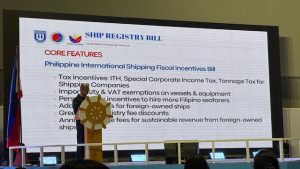
The bill also proposes import duty and value-added tax exemptions on vessels and ship equipment, incentives that are standard among many successful open registries.
Another feature provides personal tax incentives aimed at encouraging the hiring of Filipino seafarers by reducing the tax burden associated with employing Filipino crew members.
Additional incentives are also being considered for foreign vessels, recognizing that attracting foreign tonnage is central to expanding the registry and generating sustainable government revenues.
In line with global maritime sustainability trends, the bill incorporates green ship registry fee discounts to encourage the registration of environmentally compliant and energy-efficient vessels. Villaflor said the provision aligns the Philippine registry with the International Maritime Organization’s decarbonization agenda and positions the country as a forward-looking flag state that rewards sustainable shipping practices.
Finally, the bill establishes annual tonnage fees as a reliable and sustainable revenue source. Unlike one-time registration fees, annual tonnage charges would provide a continuous stream of income to support MARINA’s regulatory functions and the long-term administration of the registry.
Collectively, Villaflor said “these fiscal measures are calibrated to make the Philippine registry not only competitive but compelling, offering ship owners a fiscally efficient, environmentally responsive, and commercially viable flag of choice.”
- Advertisement -![spot_img]()
- Advertisement -