


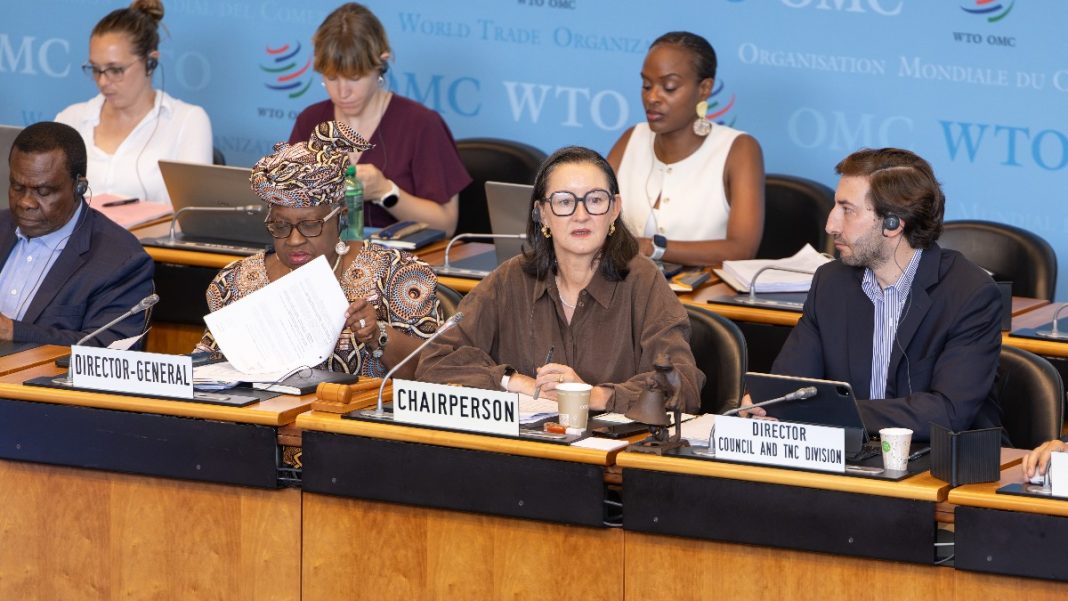
At the latest meeting of the WTO General Council held on 14–15 July, Director-General Ngozi Okonjo-Iweala and General Council Chair Ambassador Clare Kelly outlined critical steps forward for the organization, firmly establishing that institutional reform and substantive trade negotiations must progress hand in hand.
Reporting in her capacity as Chair of the Trade Negotiations Committee (TNC), DG Okonjo-Iweala rejected the notion that advancing negotiations and pursuing WTO reform are mutually exclusive.
“Reform is not an end in itself,” DG Okonjo-Iweala stated. “It is the means by which this organization can better respond to today’s challenges and deliver meaningful outcomes for members and for the people and businesses who depend on the multilateral trading system. We need to pursue both tracks together.”
The Director-General provided comprehensive updates on the state of play across major negotiating sectors as members head toward the summer break:
-
Fisheries Subsidies: The DG welcomed positive feedback on the first phase of post-MC14 negotiations, led by Ambassador Leslie Ramsammy of Guyana. A total of 122 members have now accepted the Agreement on Fisheries Subsidies (AFS), boosted by recent acceptances from the Kyrgyz Republic, Niger, and Thailand.
-
Agriculture: Farm negotiators reconvened on 9 July for the first time since MC14. While members reaffirmed agriculture’s central role, views remain divided. Developing economies emphasized the relevance of existing mandates, while others pushed for a more comprehensive, balanced approach.
-
Development and Services: The G-90 group is set to update work on outstanding Agreement-specific proposals regarding special and differential treatment after the summer break. Additionally, interest remains high in assessing trade in services under Article XIX of the GATS, though further convergence on the agenda is required.
The General Council adopted several key decisions during the two-day session:
-
LDC Group Proposals: Members agreed that future discussions on improving the implementation of the TRIPS Agreement will take place within the TRIPS Council. The Council also welcomed the launch of the third phase of the Enhanced Integrated Framework, confirming it will incur no cost to the regular WTO budget.
-
US Trade Waivers: The Council approved requests from the United States for waivers to extend duty-free treatment to eligible products under the amended African Growth and Opportunity Act (AGOA) and the Caribbean Basin Economic Recovery Act through 31 December 2026.
General Council Chair Ambassador Clare Kelly (New Zealand) reported on ongoing consultations regarding unresolved issues from MC14.
While no movement has been detected regarding the electronic commerce work programme and moratorium—or the linked TRIPS non-violation complaints moratorium—Ambassador Kelly noted that members still desire a structured, multilateral engagement on digital trade. Consultations on these issues, alongside discussions regarding Saudi Arabia’s offer to host the 15th Ministerial Conference (MC15), will resume after the summer break.
On broader WTO reform, Ambassador Kelly announced the appointment of five facilitators to assist across four priority areas identified at MC14. “With this, our WTO reform is moving on to a steady track,” she declared, noting a revised calendar aims to ensure inclusive member participation. Dispute settlement reform updates are expected at the next Dispute Settlement Body meeting on 24 July.
Addressing concerns raised by India and Pakistan regarding interim governance and administrative arrangements for the newly supported Agreement on Electronic Commerce (ECA), DG Okonjo-Iweala clarified that Secretariat resources dedicated to the ECA remain limited and transparent.
She affirmed that her decision to act as depositary for the ECA aligns with international law and WTO precedent, adding that formal written responses will be provided and that broader governance questions ultimately remain for the full WTO membership to resolve.

