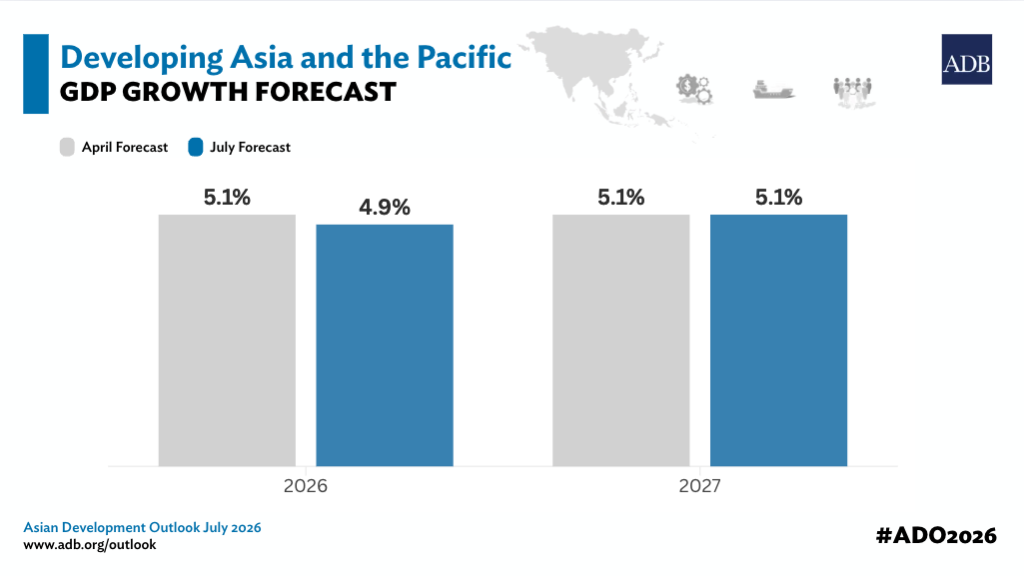
The Asian Development Bank (ADB) has lowered its 2026 economic growth forecast for developing Asia and the Pacific to 4.9%, down from a 5.5% growth rate recorded in 2025. According to the latest Asian Development Outlook (ADO) July 2026, this represents a 0.2 percentage point reduction from projections made in April.
The downward revision is primarily driven by prolonged disruptions to global energy markets stemming from the Middle East conflict, which have impacted the region’s economic prospects more heavily than previously anticipated. However, the growth forecast for 2027 has been maintained at 5.1%, reflecting an expected recovery as these geopolitical pressures begin to ease.
Despite a landmark framework agreement signed in June, the ADO July 2026 notes that energy market disruptions are expected to unwind only gradually. The ripple effects have extended beyond fuel to fertilizers, commodity prices, and broader supply chains, causing persistent inflationary pressures.
Consequently, regional inflation is now forecast to hit 4.3% this year—an upward revision of 0.7 percentage points from April, and a notable jump from the 3.0% inflation rate seen in 2025. The inflation forecast for 2027 is projected to stabilize at 3.4%.
“Durable implementation of the framework agreement would help normalize global energy markets, but the pace of adjustment is highly uncertain with significant downside risks,” said ADB Chief Economist Albert Park. “Economic growth in developing Asia and the Pacific remains resilient, but persistent headwinds caused by the conflict require a careful policy balance between supporting growth and containing inflation.”
The report highlights several compounding risks to the region’s outlook, including:
-
Renewed Conflict Escalation: Prolonged geopolitical uncertainty could further tighten energy markets, elevate risk premia, and intensify external economic pressures.
-
Tighter Financial Conditions: Rising sovereign bond yields and borrowing costs are increasing fiscal deficits across several regional economies.
-
Trade and Food Security Threat: Elevated trade policy uncertainty and higher tariffs threaten regional activity, while surging fertilizer prices pose a direct risk to agricultural output and food security.
Growth projections for 2026 were trimmed across most subregions, with developing East Asia standing out as a notable exception.
-
People’s Republic of China (PRC): Growth forecasts remain unchanged at 4.6% for 2026 and 4.5% for 2027, buoyed by robust infrastructure investment and strong export performance.
-
India: The 2026 growth forecast has been revised downward to 6.6% as elevated energy costs temper domestic demand. The projection for 2027 is maintained at 7.3%.
-
Southeast Asia and the Pacific: Growth outlooks for both subregions have been lowered, reflecting cooled domestic demand, sluggish tourism recovery, rising inflation, and escalating import costs.