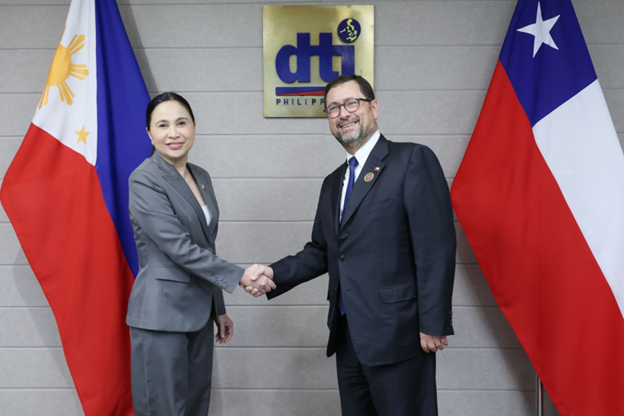
The Republic of the Philippines and the Republic of Chile have successfully concluded negotiations for the Philippines–Chile Comprehensive Economic Partnership Agreement (PH–CL CEPA), marking a historic milestone as the Philippines’ first free trade agreement (FTA) with a Latin American country.
The successful conclusion of the negotiations comes at a particularly meaningful time as the Philippines and Chile celebrate the 80th anniversary of diplomatic relations in 2026, underscoring the deepening partnership between the two countries and their shared commitment to expanding economic cooperation.
Trade and Industry Secretary Cristina A. Roque welcomed the conclusion of the negotiations during her meeting on Friday, July 24, with Chile’s Minister of Foreign Affairs, H.E. Francisco Pérez Mackenna.
She emphasized that the agreement reflects the Marcos Jr. Administration’s commitment to expanding the Philippines’ network of high-quality trade agreements, advancing the country’s trade agenda while creating greater opportunities for Filipino businesses, workers, farmers, consumers and investors.
The PH–CL CEPA is a comprehensive and modern agreement that goes beyond traditional tariff liberalization. It establishes a modern framework for deeper cooperation in trade, investment, the digital economy and incorporates commitments to sustainability, inclusivity and economic resilience, as reflected in its chapters on Environment, Labor, Global Value Chains, and Trade and Gender.
The agreement builds on the complementary nature of the two economies. The Philippines exports electronic products, coconut products and personal care products to Chile, while importing copper ores and concentrates, salmon and other key products from Chile.
The reliable supply of copper is particularly important in supporting the Philippines’ semiconductor, electronics, renewable energy and advanced manufacturing industries.
By leveraging these complementary strengths, the CEPA creates new opportunities for collaboration across value chains, technology exchange, investments and the adoption of sustainable practices.
The conclusion of the CEPA comes as bilateral trade between the two countries continues to grow. As of 2025, Chile is the Philippines’ 51st trading partner, 49th export market, and 48th import source.