


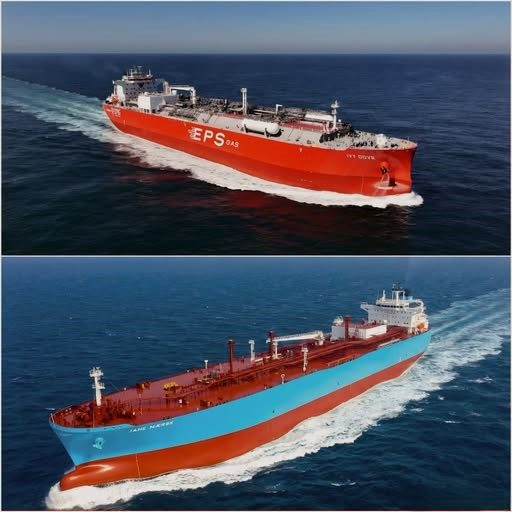
Competition between Chinese and South Korean shipbuilders in the high-value vessel sector has intensified significantly, expanding beyond LNG carriers into Very Large Ammonia Carriers (VLACs).
Driven by the surging global demand for ammonia as both a future zero-carbon marine fuel and an efficient hydrogen carrier, the global gas shipping market is undergoing a structural evolution.
According to latest industry data, shipowners worldwide placed public orders for 40 VLACs between January and July 2026. Chinese shipyards have captured the lion’s share of the market, securing 26 contracts, while South Korean shipbuilders won 14.
Chinese shipyards have demonstrated a major surge in sophisticated gas carrier construction—a high-value segment traditionally dominated by South Korean rivals. The 26 Chinese orders are distributed as follows:
-
Hengli Heavy Industries: 14 vessels (88,000 cbm and 93,000 cbm designs) for international owners including Greece’s Evalend, Dynacom, and Capital Maritime, and Dubai’s Emarat Maritime. Hengli also scored a major technical triumph on June 23, 2026, launching the world’s first 93,000-cubic-metre VLAC constructed on a traditional slipway rather than a dry dock, challenging long-standing industry norms.
-
Jiangnan Shipyard: 10 vessels commissioned by Singapore’s Eastern Pacific Shipping, Southwest Maritime, Greece’s Thenamaris, and CYH Shipping, with deliveries slated for 2028–2030. Jiangnan marked a historic milestone on June 10, 2026, with the delivery of IVY COVE—China’s first 93,000-cubic-metre VLAC built on its fourth-generation Panda 93A design. Notably, IVY COVE (the first in a six-ship series for Eastern Pacific Shipping) was delivered roughly one month ahead of Jane Maersk, a comparable vessel delivered by HD Hyundai Samho.
-
Yangzijiang Shipbuilding: 2 vessels (88,000 cbm) ordered by UK-based Union Maritime, with deliveries set for 2029–2030.
South Korean yards continue to fiercely contest the high-value segment, leveraging advanced engineering and robust orderbooks:
-
HD Hyundai Samho: Secured 11 VLAC orders—including nine from Synergy Shipping (a joint venture linked to Türkiye’s Ciner Group) and two for Belgium’s Transpetrol—with deliveries scheduled between 2029 and 2030. As of July 2026, HD Hyundai Samho holds an impressive orderbook of 22 VLACs, positioning the broader HD Hyundai Group as the leading South Korean builder in this category.
-
Hanwha Ocean: Secured three VLAC orders from UK-based Zodiac Maritime, lifting its total VLAC orderbook to 10 vessels by April 2026.
As global trade in ammonia accelerates—primarily driven by its dual utility as a long-distance hydrogen carrier and a low-carbon marine fuel—demand for dedicated VLACs capable of transporting massive volumes continues to climb.
Market momentum is further reinforced by long-term decarbonization outlooks. The International Energy Agency (IEA) projects that ammonia’s share of marine fuel consumption could surge from 8% in 2030 to an incredible 46% by 2050 under its net-zero scenario.
As shipbuilders race to deliver next-generation clean-energy transport solutions, the rivalry between Chinese and South Korean shipbuilders in ammonia-fuelled technologies is poised to shape the maritime landscape for decades to come.

