


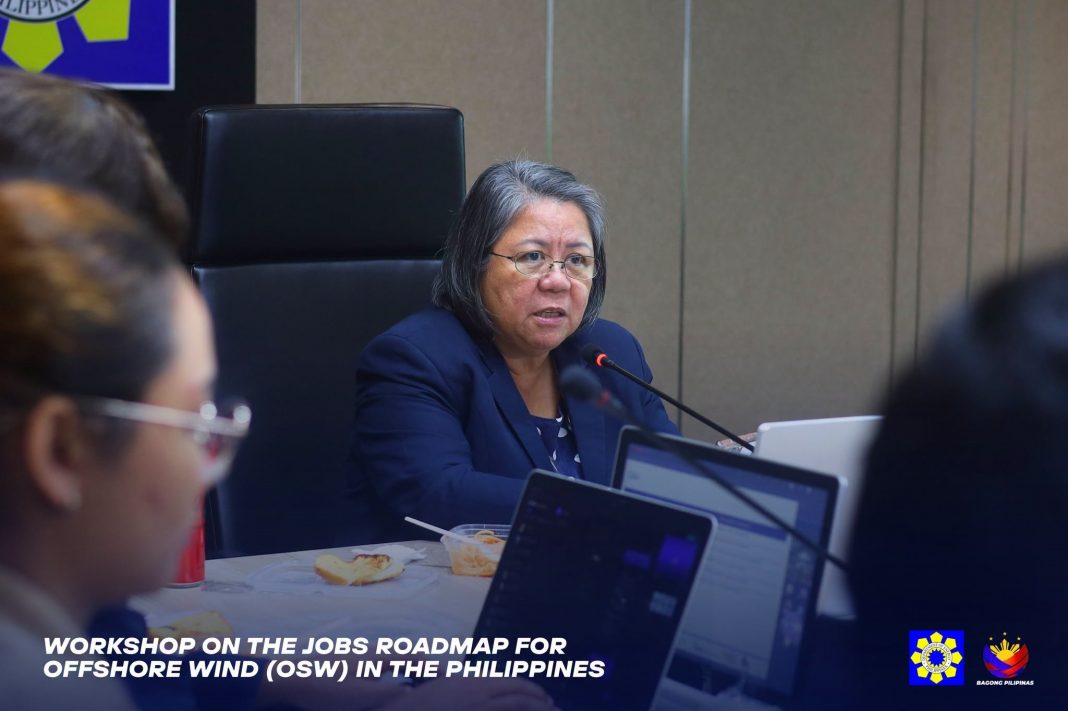
The Department of Energy (DOE), through Undersecretary Rowena Cristina L. Guevara, underscored the critical importance of human capital development during the recent Workshop on the Jobs Roadmap for Offshore Wind (OSW) in the Philippines.
Delivering the opening remarks, Undersecretary Guevara called for proactive measures to equip the Filipino workforce with the specialized skills required by the country’s rapidly emerging offshore wind sector.
The high-level workshop brought together key government agencies, academic institutions, and international industry leaders—including the International Finance Corporation (IFC), the Department of Labor and Employment (DOLE), the Technical Education and Skills Development Authority (TESDA), Mapúa University, NES Fircroft, and BVG Associates.
The primary objective of the workshop was to review and validate the draft roadmap designed to cultivate essential skills across every stage of the OSW project lifecycle, from initial site development and construction to operations and decommissioning.
Drawing a parallel to the nation’s rich maritime heritage, Undersecretary Guevara likened the scale and technical demands of offshore wind development to shipbuilding. She emphasized that targeted training programs for local engineers, maritime professionals, seafarers, and technicians must be established well before turbine installation begins.
“Developing our offshore wind capacity is not just about harnessing clean energy; it is about empowering our people. By preparing our workforce today, we ensure that the green energy transition generates high-value career opportunities, establishes world-class regional expertise, and delivers long-term, tangible benefits to Filipino communities,” said DOE Undersecretary Rowena Cristina L. Guevara.
The validation workshop marks a pivotal milestone in institutionalizing public-private partnerships aimed at bridging the skills gap in the renewable energy sector. By aligning educational curricula, technical vocational training, and industry standards, the collaborative initiative seeks to position the Philippines as a regional hub for offshore wind engineering and operations.
As the country advances toward its ambitious renewable energy targets, the DOE remains steadfast in ensuring that the transition to a low-carbon economy serves as a powerful engine for inclusive economic growth and job creation.

