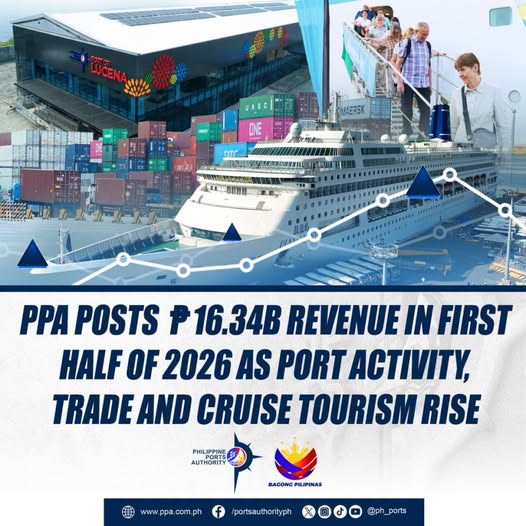
PPA revenue collection rises 11% to PHP16.34 B in H1, exceeds target on higher cargo, cruise tourism
The Philippine Ports Authority (PPA) registered an 11.31 percent increase in revenue to PHP16.34 billion in the first half of 2026 from PHP14.68 billion in the first period last year, on higher cargo volumes, container traffic and cruise ship calls, underscoring broader economic activity on Philippine ports.
Official PPA data showed that its revenue collection from January to June already exceeded by 7.61 percent, or by PHP1.16 billion its target for the first half of this year.
PPA General Manager Jay Daniel R. Santiago, the latest data reflects the continuing implementation of a strategy focused on stronger operational performance, infrastructure modernization, revenue optimization and improving the capacity of ports to support the country’s expanding economy.
The strong first half performance comes as the Marcos administration continues to prioritize the modernization and expansion of the country’s transport infrastructure, including ports, to improve connectivity, increase capacity and support economic growth.
In his recent State of the Nation Address, President Ferdinand R. Marcos Jr. underscored the importance of improving and expanding ports across the country as part of the administration’s broader infrastructure agenda.
Strong trade, cargo
The growth in revenues was supported by sustained activity across the PPA-managed port network. From January to June, PPA handled 154.03 million metric tons of cargo, representing a 3.08 percent increase from the 149.42 million metric tons recorded during the same period in 2025. Container traffic likewise continued to expand, with ports handling 4.30 million twenty-foot equivalent units (TEUs), up 2.65 percent from 4.19 million TEUs recorded in the first half of last year.
Notably, the increase in cargo throughput was supported by higher shipments of key commodities handled by several PPA Port Management Offices, including crude minerals at PMO Eastern Leyte/Samar and metalliferous ores at PMO Surigao and PMO Zamboanga del Norte.
Containerized cargo activity was likewise supported by increased operations at PMO NCR North, PMO Palawan and PMO Batangas, as well as higher foreign container activity at PMO NCR South, PMO Davao and the Manila International Container Terminal (MICT).
GM Santiago noted that the sustained growth in cargo and container traffic demonstrates the importance of an efficient and reliable port system in supporting supply chains, businesses and industries across the country.
“Ports are at the center of the movement of goods and economic activity in an archipelagic country like the Philippines. Every improvement we make in efficiency, capacity and connectivity helps businesses move products faster, supports local industries and strengthens the country’s competitiveness,” GM Santiago added.
Expanding cruise tourism
Beyond trade, Philippine ports also continued to benefit from the expansion of cruise tourism. During the first six months of 2026, PPA ports recorded 70 cruise ship calls, representing a 4.48 percent increase from the same period in 2025. The vessels brought 165,340 cruise passengers to destinations across the country, generating opportunities for local tourism enterprises through shore excursions, cultural and heritage tours, sightseeing, shopping and other tourism activities.
“Every cruise ship call creates opportunities that go beyond the port. It brings international visitors closer to our communities, local businesses, tourism destinations and cultural attractions. Our responsibility is to ensure that Philippine ports are ready to welcome these opportunities and provide every visitor with a safe, efficient and world-class gateway to the country,” GM Santiago emphasized.
Cruise tourism activity during the period extended beyond Manila, with international vessels calling at ports in Ilocos Sur, Ilocos Norte, Pangasinan, Palawan and other destinations included in Philippine cruise itineraries. Some vessels also made multiple port calls within the country, allowing passengers to experience several Philippine destinations during a single voyage and spreading tourism activity across different regions.
Through its Port Management Offices, the PPA continues to coordinate with local government units, tourism stakeholders and other government agencies to facilitate safe, orderly and efficient cruise operations and strengthen the connection between international visitors and local destinations.

Passenger traffic
Passenger traffic also contributed substantially, with PPA recording 45.69 million passenger movements during the six-month period.
The figures highlight the continuing importance of the country’s port network not only to commerce and tourism but also to the daily mobility and connectivity of millions of Filipinos across the archipelago. The first-half results reinforce the PPA’s position as one of the country’s major contributors to the government’s infrastructure, connectivity and economic development agenda.
With trade volumes continuing to expand, cruise tourism gaining momentum and passenger traffic remaining robust, PPA will continue pursuing infrastructure modernization, operational efficiency and digital transformation across its port network. The PPA’s first-half performance signals continued momentum for the country’s maritime sector as Philippine ports increasingly serve as strategic engines for trade, tourism, connectivity and inclusive economic growth.
“Our performance in the first half of the year shows that the investments and reforms we have been pursuing across the port system are translating into real results. We are seeing sustained activity in trade, stronger connectivity, growing tourism, and improved revenues, all of which strengthen our capacity to further invest in better and more modern ports for the Filipino people,” GM Santiago said.
Under Santiago’s leadership, the PPA has continued to push its Bagong Pantalan sa Bagong Pilipinas agenda, positioning ports not merely as transport facilities but as strategic gateways that connect industries, communities and local economies to domestic and international markets.
- Advertisement -![spot_img]()
- Advertisement -