



The Department of Economy, Planning, and Development (DEPDEV), the government’s macroeconomic architect, said it is now “very unlikely” that the Philippines will meet its already downgraded 2025 growth target of 5.5 percent to 6.5 percent.
“Honestly, that’s very unlikely now. We need to grow roughly 7 percent in the fourth quarter to achieve a 5.5 percent growth for the year. And given the situations and the data that are coming out, that’s quite unlikely,” DEPDEV Secretary Arsenio Balisacan said during a year-end press chat on Monday.
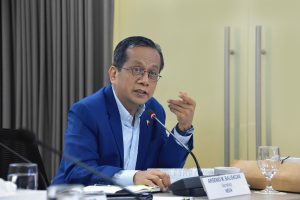
(Photo credit: https://depdev.gov.ph/)
Balisacan noted that the first three quarters delivered 5 percent growth. “And if we can sustain that 5% for the year, that still gives me quite a respectable growth,” he added. The fourth quarter has been marked by devastating typhoons and earthquakes, along with protest rallies over government corruption.
Nonetheless, Balisacan said that achieving 5 percent growth in 2025 would still place the Philippines in the middle of the pack in the region. “Our intention is to move back to the top share of these Asian countries next year,” he said.
The Philippine economy posted an average 5 percent growth in the first nine months of 2025, as third-quarter GDP slowed to 4.0 percent—the weakest in four years and the lowest since the 3.8 percent recorded in the first quarter of 2021, at the height of strict COVID-19 lockdowns.
The domestic economy grew 5.6 percent in 2024, below the 6.0 percent–6.5 percent goal, and 5.5 percent in 2023, falling short of the 6.0 percent–7.0 percent target.
Upper-middle-income status
On the impact of weaker growth on the country’s goal of reaching upper-middle-income status by 2025, Balisacan said that assuming the economy ends the year with 5 percent growth and the population expands by 1.6 percent to 1.7 percent, the target should still be achievable. This will be confirmed once the World Bank releases its updated assessment in July next year.
Per capita income is the primary metric for determining upper-middle-income status, measured through gross national income (GNI) per capita. The Philippines is now only facing “a small hurdle” to enter the bracket.
Based on the World Bank’s latest assessment, the country’s GNI per capita stood at USD 4,470 in 2024, just USD 26 short of the threshold for upper-middle-income classification.
Good fundamentals
Meanwhile, Balisacan emphasized that the domestic economy is not “collapsing” stressing that the economic fundamentals are good. Indicators of an economy going haywire include deficits going out of control, debt ballooning, the banking system saddled with debts, particularly consumer borrowing, inflation going back, and capital flight. “If you look at our macro fundamentals, those indicators today, they’re so good, they remain strong,” he said.
In fact, he cited why some of the credit rating agencies maintained their rating for the country. “We don’t hear any such deterioration, concerns of deterioration,” he said.
Thus, he said, the economic managers team are focused on ensuring these fundamentals remain and not to lose control of that. He added that President Marcos Jr. is also focused on ensuring that the “economic gains that we have achieved will not be eroded and that will continue our momentum to achieving, to joining our peers in the region.”
While no one can foretell what will happen in the next six months, he stressed that the “best we can do is to ensure that the fundamentals, economic fundamentals are robust so that the economy will be able to stand firmly.”

