


The World Trade Organization (WTO) has released its latest trade monitoring report, highlighting a dramatic increase in the trade coverage of import-restrictive measures, primarily tariffs, over the past year. The report, “Overview of Developments in the International Trading Environment,” covers the period from mid-October 2024 to mid-October 2025.
Impact on Imports: Imports worth USD 2,640 billion, representing 11.1 per cent of total world imports, were affected by new trade-restrictive measures, predominantly tariffs. This figure is more than four times the USD 611 billion recorded in the preceding 12-month period.
Total Affected Trade: Including similar measures on exports, the total value of global trade affected reached approximately USD 2,966 billion, over three times the amount reported previously (USD 888 billion).
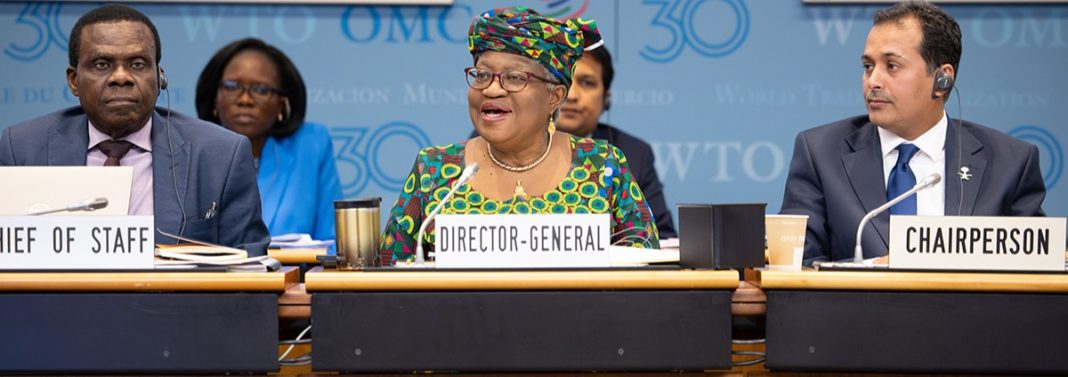
Cumulative Effect: WTO Director-General Ngozi Okonjo-Iweala noted, “The sharp jump in the trade coverage of tariffs reflects the increased protectionism we have seen since the start of the year. Nearly a fifth (19.7 per cent) of world imports are now affected by tariffs and other such measures introduced since 2009—compared to 12.6 per cent only a year ago.”
Goods Trade Facilitation: WTO members and observers introduced 331 new trade-facilitating measures on goods. These measures cover trade valued at an estimated USD 2,090 billion, which is approximately 1.5 times higher than the USD 1,441 billion recorded in the last report.
Services Trade Facilitation: On services, 124 new measures were introduced, a level consistent with recent years. The majority of these measures were aimed at facilitating trade or improving regulatory frameworks, with a focus on commercial presence (Mode 3) and the movement of professionals (Mode 4), as well as Internet and network-enabled services.
Merchandise Trade Forecast: WTO economists estimate world merchandise trade growth at 2.4 per cent in 2025 and 0.5 per cent in 2026. The stronger-than-expected growth in the first half of 2025 is driven by import frontloading, robust demand for AI-related products, and continued trade expansion among developing economies.
Trade Remedy Investigations: The initiation of trade remedy investigations—such as anti-dumping cases—averaged 32.3 per month, just below the 2024 peak. This suggests a potential future increase in imposed measures, particularly as the average number of terminations (11.4 per month) remains among the lowest since 2012, indicating that many existing actions are kept in place.
Director-General Okonjo-Iweala emphasized the need for action: “At the same time, we see members acting to facilitate trade and engaging in dialogue rather than retaliation. This speaks to the value they continue to see in maintaining smooth cross-border trade flows. WTO members should use the current trade disruptions to advance long-overdue reforms of the WTO.”
She concluded that reforms would allow members to “tackle some of the underlying concerns linked to recent unilateral measures, while repositioning the WTO to better help them seize exciting new trade opportunities.”
The “Overview of Developments in the International Trading Environment” reports have been published continuously since 2009 to assist the Trade Policy Review Body in analyzing the impact of international trade developments on the multilateral trading system.

