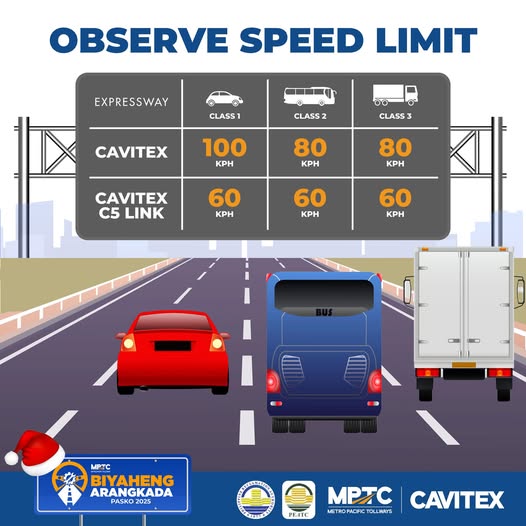
CAVITEX (Manila-Cavite Expressway) and the CAVITEX C5 Link are reinforcing their commitment to commuter safety by reminding all motorists to strictly observe the designated speed limits across its network.
As part of its ongoing “Safe and Smooth Journey” initiative, expressway management emphasizes that maintaining the correct speed is not just a legal requirement, but a critical factor in preventing accidents and ensuring efficient traffic flow for the thousands of daily road users.
Speed regulations are categorized by vehicle classification to manage the different kinetic profiles of light cars versus heavy-duty trucks. Motorists are required to maintain speeds within the following ranges:
| Vehicle Classification | Minimum Speed | Maximum Speed |
| Class 1 (Cars, SUVs, Jeepneys) | 60 KPH | 100 KPH |
| Class 2 & 3 (Buses, Trucks) | 60 KPH | 80 KPH |
Adhering to these limits serves two primary purposes:
-
Safety: The 80 KPH cap for larger vehicles (Class 2 & 3) accounts for longer braking distances, reducing the risk of multi-vehicle collisions.
-
Traffic Flow: The 60 KPH minimum speed prevents “bottlenecking,” ensuring that the expressway remains a high-speed thoroughfare rather than a congested road.
“Road safety is a collaborative effort,” said a spokesperson for the expressway. “By keeping your speed in check, you aren’t just protecting yourself—you are ensuring a predictable and secure environment for every family and business traveler sharing the road with you.”
Patrol teams and speed cameras are active along the CAVITEX and C5 Link corridors to monitor compliance and assist motorists in distress.