


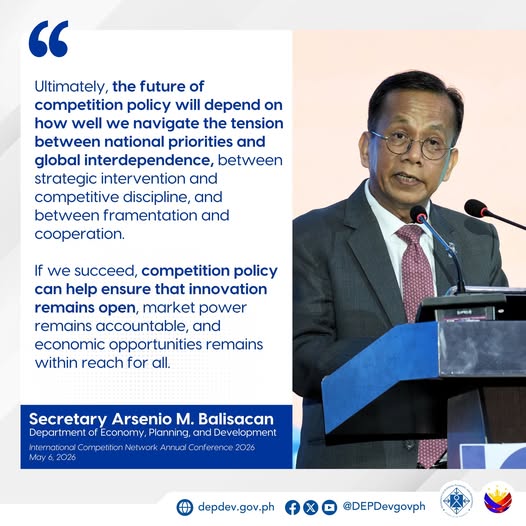
Speaking at the International Competition Network (ICN) Annual Conference 2026, Philippines’ Department of Economic Planning and Development (DEPDev) Secretary Arsenio M. Balisacan underscored the dual role of competition policy as a rigorous enforcement mechanism and a primary driver of national development.
Addressing an assembly of competition authorities and experts from over 140 jurisdictions, Balisacan—who previously served as the inaugural Chairperson of the Philippine Competition Commission (PCC)—shared insights on how competitive markets serve as the bedrock for productivity, innovation, and inclusive growth.
In his keynote, Balisacan emphasized that competition policy is not merely a legal hurdle but a strategic tool to attract high-quality investment. He noted that the effectiveness of such policies relies heavily on legal discipline, institutional capacity, and sound economic analysis.
“In an era defined by geopolitical tensions and trade fragmentation, competition policy is our best defense in keeping markets open and responsive,” Balisacan stated. “It ensures that the global economy remains dynamic rather than stagnant.”
The Secretary called for a “new era of international cooperation” to address the complexities of interconnected global markets. He urged the ICN community to strengthen collaborative efforts in several key areas:
-
Enforcement: Joint cartel investigations and streamlined merger reviews.
-
Knowledge Exchange: Sharing evidence and aligning analytical approaches to remedy design.
-
Digital Governance: Developing unified frameworks to address data-driven advantages and innovation-related harms in the age of Artificial Intelligence.
Balisacan also addressed the relationship between competition and industrial policy, noting that the two must be complementary. He argued that competition ensures industrial interventions remain targeted and efficient, preventing market distortions.
As the digital economy continues to evolve, Balisacan concluded with a call for sustained collaboration to ensure that emerging technologies—specifically AI—expand economic opportunities for all sectors of society rather than concentrating power in the hands of a few.

