


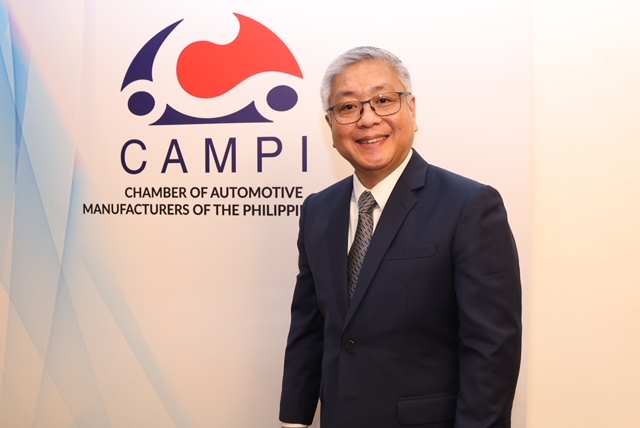
The domestic automotive manufacturing industry is appealing for a parallel incentives scheme to support traditional or internal combustion engine (ICE) vehicle production, particularly for vehicle types that are vital to micro, small, and medium enterprises (MSMEs).
This call was raised by Jose Maria “Jing” Atienza, president of the Chamber of Automotive Manufacturers of the Philippines Inc. (CAMPI), as the government is finalizing the guidelines for the Electric Vehicle Incentive Strategy (EVIS), an incentive-driven program designed solely to attract electric vehicle (EV) manufacturing investments into the country.
“We see the growth and requirement not only in the provinces, but MSMEs for such vehicles,” said Atienza, emphasizing that if there is sustained demand and a clear advantage to manufacturing these vehicles locally, “it would help if there’s assistance from the government.”
Atienza added that several vehicle segments remain in strong demand—not only one-ton pickups, but also multipurpose vehicles (MPVs), which play a crucial role in improving mobility, especially in provincial areas.
“I wouldn’t want to say any specific model at this time, but what I just want to say is, the Philippines would need a lot of vehicles or vehicle types. And yes, manufacturing is important, and we do hope also that any type of vehicle, when manufactured (locally), there will be some equal support,” he emphasized.
He pointed to the continued growth of one-ton pickups and MPVs such as the Tamaraw and L-300, which are widely used to meet the operational needs of MSMEs, particularly outside urban centers.
“So what we manufacture should be those which are needed by the customers,” he said.
He further explained that as the economy expands, so does the demand for a diverse mix of vehicles, including ICE models, alongside electrified options. “So talking about support for manufacturing, so it should be broader,” he said.
Atienza, who also serves as vice president of Toyota Motor Philippines, highlighted the company’s ongoing commitment to local manufacturing. Toyota continues to produce models such as the Vios, Innova, and Tamaraw at its plant in Sta. Rosa, Laguna.
The company also participated in the Comprehensive Automotive Resurgence Strategy (CARS), a time-bound, performance-based incentive program for car manufacturing. He noted that the initiative proved effective in supporting industry growth.
“And as Toyota, it also helped us a lot,” he added.

