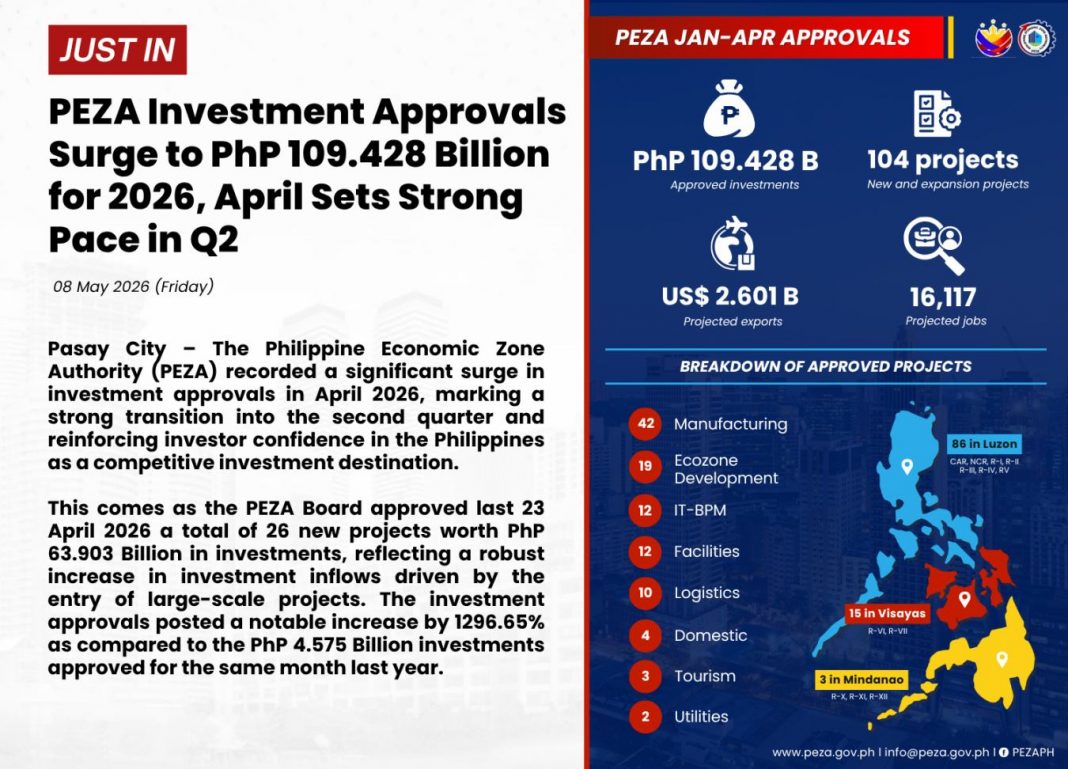
Project registration with the Philippine Economic Zone Authority (PEZA) soared 1,296 percent in April to PHP63.903 billion from only PHP4.575 billion in the same month in 2025.
PEZA Director General Tereso O. Panga reported Friday, May 26, they approved 26 new projects, which are expected to generate USD1.695 billion worth of exports and 7,621 direct jobs once fully operational.
Among these projects, the PEZA Board also greenlighted five big-ticket projects totaling PHP60.016 billion in investments. These include tw EMS-SMS companies and one tourism development project which will expand its operations in Baguio, Clark, and Cebu; one facilities enterprise in Iloilo and one ecozone development venture in Tarlac.
Region IV-A (CALABARZON) emerged as the primary investment hub for the month, accounting for (15) projects, followed by Region VII with five projects, Region III with three, and Regions VI, XI and Cordillera Administrative Region (CAR) with one project each.
Year-on-Year Performance
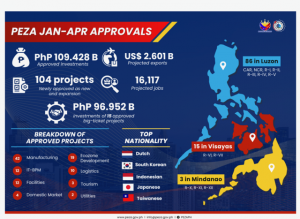
The April approval has brought PEZA’s total from January to April 2026 to PHP109.428 Billion, 72.27 percent higher than the PHP63.523 billion approval for the same period last year.
PEZA’s approved 104 new and expansion projects also indicated a 20.93 percent increase from 86 projects in the same period last year, signaling a more active and expanding investment pipeline. These projects are seen to generate US$2.601 billion in exports and 16,117 direct jobs, reinforcing the Philippines’ growing role in global value chains and export-oriented industries.
Manufacturing led all sectors with 42 projects, followed by ecozone development (19), IT-BPM (12), facilities (12), logistics (10), tourism (3), domestic (4) and utilities (2)—demonstrating both industrial depth and continued strengthening of support infrastructure across ecozones. Geographically, investments remained concentrated in Luzon (86 projects), with steady activity in the Visayas (15) and emerging presence in Mindanao (3), in line with PEZA’s push for more balanced regional development.
This momentum is supported by a diversified investor base led by Dutch, South Korean, Indonesian, Japanese, and Taiwanese firms, indicating sustained international confidence in the country’s investment environment.
“These figures reflect our resilience even as the global economy navigates a complex period of recovery,” DG Panga said. “While we remain mindful of the prevailing global headwinds and supply chain pressures, the Philippines continues to offer a sense of stability for capital. For our part, we are focused on ensuring that these investments translate into steady, reliable opportunities for our employees and locators,” he added.
Supply chain
Recent shifts in the global trade landscape, characterized by changing manufacturing footprints and evolving geopolitical alliances, have prompted multinational firms to seek more secure and integrated production hubs. As global supply chains move toward “friend-shoring” and regional diversification, the ability to provide a predictable and efficient regulatory environment has become a critical differentiator for investment destinations. DG Panga underscored that the Philippines is strategically leveraging on these transitions to capture high-value opportunities.