


President Ferdinand R. Marcos Jr. inaugurated the first-ever Light Craft Landing Station (LCLS) and inspected the Port Operations Building (POB) at the Port of Benoni in Mahinog, Camiguin, marking another milestone in the Marcos Administration’s efforts to modernize the country’s port infrastructure, strengthen inter-island connectivity, and support inclusive regional development.
Joining the President during the inauguration were Department of Transportation (DOTr) Acting Secretary Giovanni Lopez, Philippine Ports Authority (PPA) General Manager Jay Santiago, local government officials, and key stakeholders from the maritime transport sector.
Serving as Camiguin’s primary maritime gateway to mainland Mindanao and Bohol through the Ports of Balingoan and Jagna along the Central Nautical Highway, the Port of Benoni has continued to experience significant growth in passenger and vehicle traffic.
Passenger volume increased from 455,602 in 2022 to 792,803 in 2025, while vehicle traffic likewise grew from 76,341 to 129,066 during the same period, reflecting the province’s expanding tourism industry and increasing economic activity.
Modern infrastructure
To address rising demand and improve passenger services, PPA developed a modern Port Operations Building designed as a one-stop facility that streamlines frontline services while providing larger passenger waiting areas, improved amenities, and enhanced safety features. The building also houses the Terminal Management Office and partner government agencies, strengthening operational efficiency, inter-agency coordination, and public service delivery.
Complementing the operations building is the Port of Benoni’s first-ever dedicated Light Craft Landing Station. The project includes a new berthing facility, trestle, and a two-storey landing station that provides a dedicated area for light vessel operations. By separating light craft activities from the main port, the facility improves vessel movement, enhances navigational safety, minimizes congestion, and increases overall operational efficiency while providing a safer and more convenient travel experience for residents and visitors alike.
Together, these complementary projects significantly enhance the port’s capacity to accommodate increasing passenger traffic, vessel movements, and tourism-driven economic growth while ensuring more efficient and reliable maritime services for Camiguin.
Beyond improving transport services, the facilities are expected to generate lasting economic benefits by strengthening tourism, facilitating the efficient movement of people and goods, and creating greater opportunities for local communities across the island.
Passengers will benefit from safer, faster, and more convenient travel through improved passenger processing facilities, enhanced amenities, and modern safety features. Transport operators, including passenger vessels, light craft operators, cargo haulers, and vehicle transport services, will likewise benefit from dedicated berthing facilities that improve vessel turnaround time, enhance navigational safety, and support more efficient port operations.
The upgraded infrastructure is also expected to improve the movement of agricultural products, fishery commodities, consumer goods, construction materials, fuel, and other essential supplies between Camiguin and mainland Mindanao. Faster and more reliable logistics will help reduce transport delays and costs, preserve product quality, strengthen supply chains, and improve the competitiveness of farmers, fisherfolk, local producers, and micro, small, and medium enterprises (MSMEs).
Port of Benoni
The modernization of the Port of Benoni likewise supports the continued expansion of Camiguin’s tourism industry by improving accessibility and accommodating increasing visitor arrivals. Hotels, resorts, restaurants, transport providers, tour operators, dive shops, souvenir stores, and other tourism-related enterprises are expected to benefit from stronger connectivity, reinforcing Camiguin’s position as one of the country’s premier island destinations.
Government agencies operating within the port, including PPA, the Terminal Management Office, the Philippine Coast Guard, and other partner agencies, will also benefit from improved office facilities that enhance coordination, regulatory functions, safety, and public service delivery.
The projects likewise generated employment opportunities during construction and are expected to sustain jobs in port operations, transportation, logistics, security, maintenance, and other support services. More importantly, they further strengthen Camiguin’s economic linkages with mainland Mindanao and the Visayas, supporting greater trade, investment, and long-term regional development.
For regular port users, the improvements represent a significant upgrade in the overall travel experience. “Sa katulad kong pasahero, mas marami na ang maeengganyong bumisita dito sa Camiguin, lalo na ngayon na napakaganda na ng Port of Benoni,” said Albert Mendez, a regular port user.
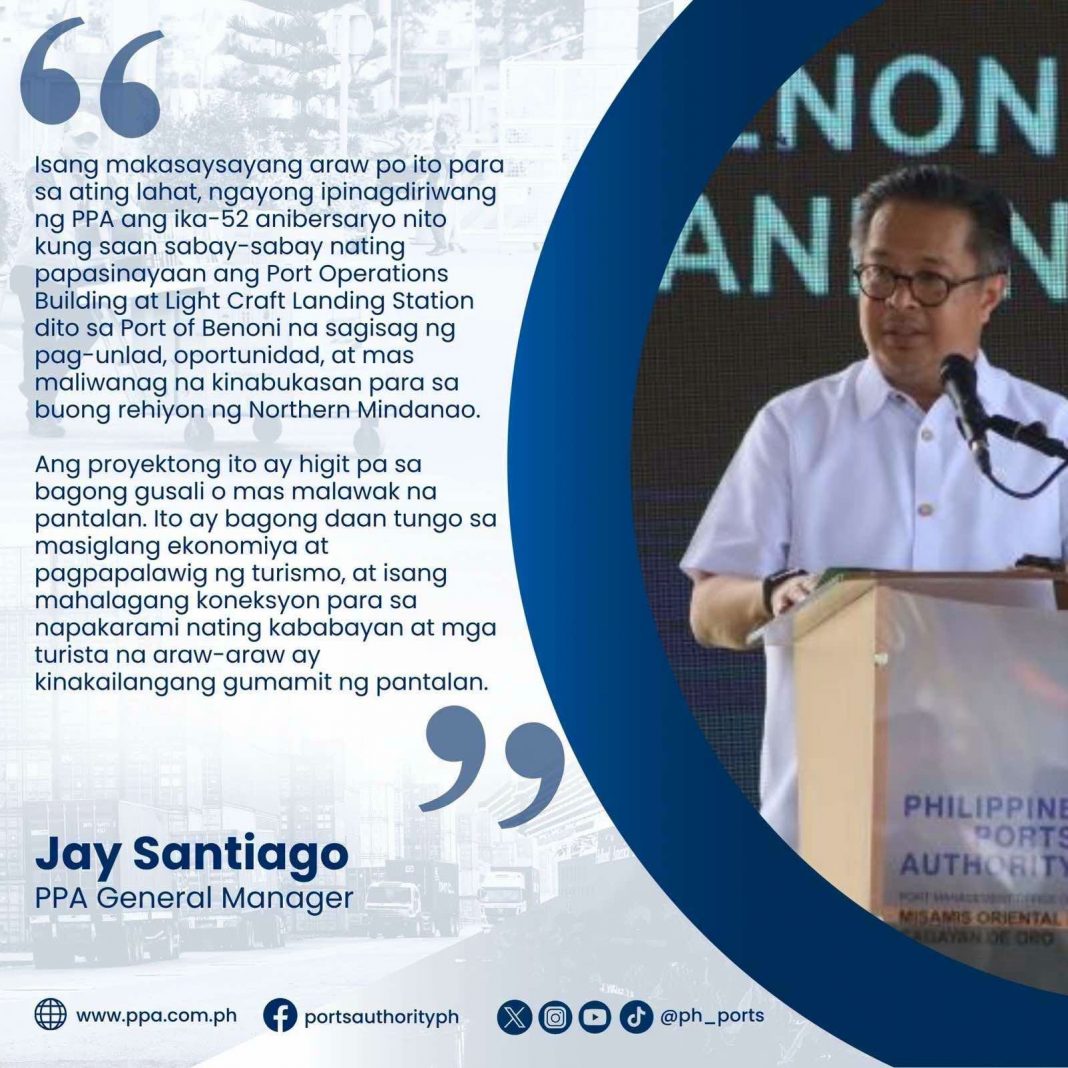
PPA General Manager Jay Santiago emphasized that the projects demonstrate the agency’s commitment to building infrastructure that delivers lasting benefits for communities.
“Our mission goes beyond constructing ports. We are building gateways that connect islands, strengthen industries, expand tourism, and create opportunities for generations of Filipinos. Every modern port we develop reflects our commitment to nation-building through infrastructure that drives inclusive growth and brings lasting progress to our communities,” Santiago said.
Anchored on its vision of building smarter, greener, safer, and more resilient ports, PPA continues to invest in modern infrastructure that enhances operational efficiency while serving as a catalyst for tourism, trade, and regional development.
The inauguration of the first-ever Light Craft Landing Station, together with the Port Operations Building, further strengthens the Port of Benoni’s role as Camiguin’s primary maritime gateway. These developments support the province’s long-term growth while advancing PPA’s commitment to developing modern, resilient, and world-class ports that improve connectivity, enhance public service, and create greater opportunities for every Filipino.

