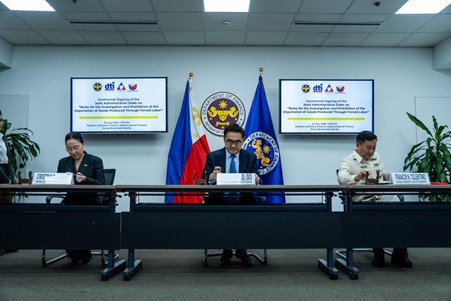
The Department of Trade and Industry (DTI), Department of Labor and Employment (DOLE), and Department of Finance (DOF) today, July 24, signed a Joint Administrative Order (JAO)
prohibiting importation of goods produced through forced labor as the U.S. Trade Representative announced the imposition of tariffs on trading partners, including the Philippines, over alleged use of forced labor on products exported to the U.S. markets.
The JAO, signed by Finance Secretary Frederick D. Go, DTI Secretary Cristina A. Roque, and Labor Secretary Francisco Tolentino, creates an Inter-Agency Committee chaired by the DTI, with the DOLE as Vice-Chair and the DOF, Bureau of Customs (BOC), Board of Investments (BOI), and Philippine Economic Zone Authority (PEZA) as members, and establishing the rules for the investigation and prohibition of the importation of goods produced wholly or in part through forced labor, reinforcing the Philippines’ commitment to responsible trade, workers’ rights, and fair competition.
The United States Trade Representative’s (USTR) has taken action on 60 economies for their alleged failure to impose and effectively enforce a prohibition on the importation of goods produced with forced labor as provided under Section 301 of the U.S. Trade Act of 1974.
Under the JAO, the Inter-Agency Committee will receive, evaluate, and investigate complaints and information relating to imported goods suspected of having been produced through forced labor and recommend appropriate action to the relevant authorities. The Philippines does not allow forced labor, but some inputs for its exports are allegedly produced or sourced from countries that employ forced labor.
As global markets place increasing importance on ethical sourcing, responsible business conduct, and transparent supply chains, the Philippines is taking a proactive step to ensure that trade supports internationally recognized labor standards. By prohibiting the importation of goods produced through forced labor, the country strengthens confidence in the integrity of its supply chains, promotes fair and responsible business practices, and demonstrates its commitment to sustainable economic growth founded on ethical trade.
Responsible trade and trusted supply chains
Trade Secretary Cristina A. Roque emphasized that the JAO is a strategic measure that strengthens the Philippines’ position as a trusted trading partner and investment destination.
“As businesses and consumers place greater value on ethical sourcing and transparent supply chains, the Philippines must ensure that our market supports responsible business conduct. By prohibiting the entry of goods produced through forced labor, we reinforce confidence in our supply chains, promote fair competition, and signal to investors and trading partners that the Philippines is committed to sustainable and values-driven growth,” Secretary Roque said.
She added that the measure aligns the country’s trade policies with evolving global expectations for responsible and resilient supply chains, helping create an environment where legitimate businesses can thrive.
Promoting decent work and fair competition
Labor Secretary Francis N. Tolentino highlighted that the JAO advances the country’s commitment to protecting workers and promoting decent work.
“No worker should suffer exploitation for goods to become cheaper or more competitive. This JAO helps ensure that Filipino workers and enterprises are not disadvantaged by imported products produced through forced labor. It demonstrates how trade policy can support labor protection, uphold human dignity, and create a level playing field for businesses that comply with fair labor standards,” Secretary Tolentino said.
He noted that the measure reflects the Philippines’ commitment to ensuring that economic progress goes hand in hand with respect for workers’ rights and fundamental labor standards.
Enforcement through Customs
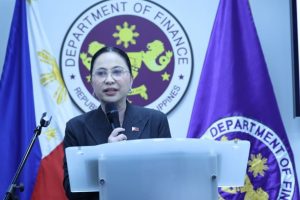
Finance Secretary Frederick D. Go underscored the importance of effective enforcement in ensuring the credibility and success of the JAO.
“A strong policy must be matched by effective implementation. Through the Bureau of Customs and close coordination with partner agencies, we will ensure that credible findings of forced labor are translated into appropriate enforcement action. This JAO strengthens our ability to safeguard the Philippine market from goods that do not meet the standards we uphold as a nation,” Secretary Go said.
Under the JAO, the Bureau of Customs will act on the findings and recommendations of the Inter-Agency Committee and implement measures to prohibit the importation of goods determined to have been produced wholly or in part through forced labor.
Align with international labor conventions
The JAO aligns with the Philippines’ obligations under international labor conventions and establishes a coordinated mechanism for investigation, information-sharing, and enforcement against imported goods suspected of being produced through forced labor. It also protects consumers, workers, importers, exporters, and legitimate businesses from the adverse effects of unfair and exploitative trade practices.
The JAO reflects the Philippines’ commitment to building an economy founded on responsible business conduct, ethical sourcing, and respect for human dignity. By strengthening safeguards against goods produced through forced labor, the Philippines reinforces trust in its market, supports fair competition, and contributes to global efforts to eliminate labor exploitation from supply chains. As the country continues to expand trade and attract investments, it remains committed to pursuing growth that is sustainable, principled, and anchored on supply chains that respect workers’ rights and create shared prosperity.
Exporters alarmed
The Philippine Exporters Confederation, Inc. (PHILEXPORT) expressed deep concern over the decision of the USTR to impose an additional 12.5-percent tariff on most Philippine exports under its Section 301 of the U.S. Trade Act of 1974 investigation relating to forced labor import prohibitions.
“The Philippines has long been a responsible trading partner of the United States and remains firmly committed to internationally recognized labor standards”, said PHILEXPORT President Sergio R. Ortiz-Luis Jr. “Our exporters operate within a legal and regulatory framework that protects workers’ rights, and many have adopted globally recognized environmental, social, and governance (ESG) and responsible sourcing practices demanded by international buyers.”
Ortiz-Luis noted that the additional tariff comes at a time when Philippine exporters are already facing significant challenges, including elevated logistics costs, global economic uncertainty, geopolitical tensions, and increasing competition from neighboring economies.
“The additional 12.5-percent duty could reduce the competitiveness of Philippine products in the U.S. market, particularly for our micro, small, and medium enterprises (MSMEs), which account for the majority of our exporters. Sectors such as furniture, garments, processed food, coconut products, handicrafts, electronics, marine products, and other value-added manufactures may experience reduced demand or pricing pressures as buyers seek alternative sources,” he said.