


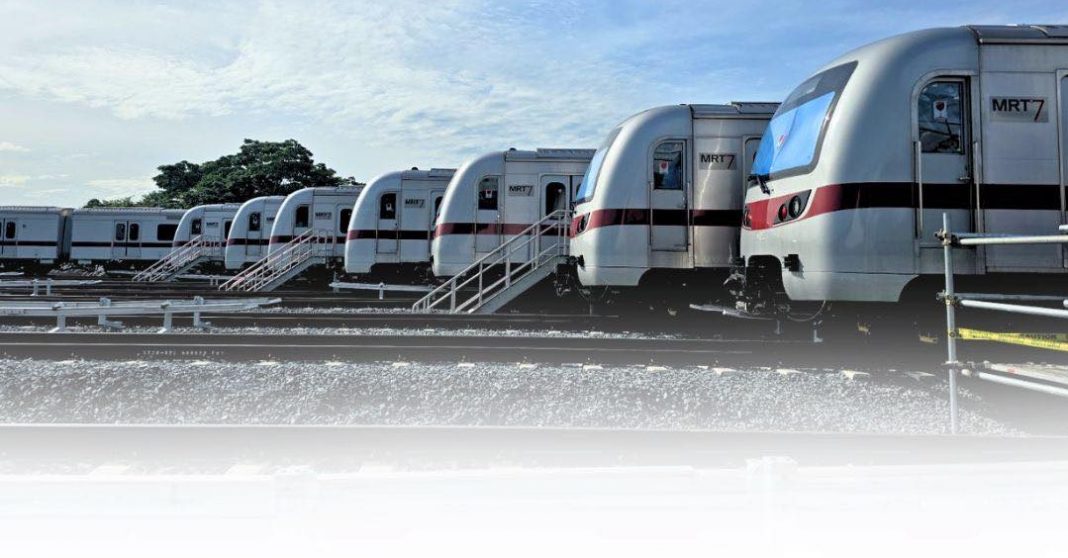
The North-South Commuter Railway (NSCR) and Metro Rail Transit Line 7 (MRT-7) will begin partial operations next year, providing Filipinos with more convenient and modern public transportation.
President Ferdinand Marcos Jr. highlighted the mass transportation projects during his penultimate State of the Nation Address (SONA) on Monday, July 27.
According to the President, the NSCR will begin operations between Valenzuela and Malolos next year. He said the Department of Transportation is working to complete the railway up to Tarlac before the end of his term.
Once completed, the NSCR will span approximately 147 kilometers from Clark, Pampanga, to Calamba, Laguna, with 36 to 37 stations. It consists of three main sections: the North Segment, connecting Pampanga and Bulacan, including Clark International Airport; the Central Segment, running from Malolos through Bulacan to Manila; and the South Segment, extending from Solis in Manila to Calamba, Laguna, through Metro Manila.
Meanwhile, the first 12 stations of the long-delayed MRT-7 are also expected to open next year, nearly three decades after the project was first proposed. Initial operations will run from North Avenue to Sacred Heart in Quezon City, with the line eventually extending to San Jose del Monte, Bulacan.
MRT-7 is a 22.8-kilometer rail project being developed by San Miguel Corporation that will connect North Avenue in Quezon City to San Jose del Monte, Bulacan. The line will have a total of 14 stations.
Meanwhile, the Ilocos Norte Bus Rapid Transit system is slated for inauguration next year, while the first phase of the Cebu Bus Rapid Transit has already begun operations.
The Marcos administration is prioritizing the completion of railway projects, bus rapid transit systems, transport hubs, and integrated terminals as more Filipinos turn to public transportation amid rising fuel costs. The government is also expanding the capacity of seaports and airports nationwide.
Marcos said the recently enacted Accelerated and Reformed Right-of-Way Act has significantly sped up the resolution of right-of-way issues, removing what he described as the biggest bottleneck in the country’s mass transit development program.
The President also reaffirmed the government’s push to accelerate the adoption of electric vehicles (EVs). He noted that tariffs on EVs have been removed until 2028 to help lower prices, while government agencies have been directed to prioritize EVs in their fleet replacement programs.
“This clean and green policy is two-pronged: it shall also spur growth of our domestic local industries across the EV value chain, specifically those involved in the vehicle assembly and manufacturing of batteries and related spare parts,” he said.
The government aims for electric vehicles to account for 50 percent of all vehicles in the country by 2040. Marcos noted that the newly introduced Love Bus units in Davao City are already fully electric.

