


Office space vacancy rates in Metro Manila remain high due to a continued influx of new supply, but are expected to ease to the “teens” by next year, according to a new report by real estate consultancy and management firm Santos Knight Frank (SKF).
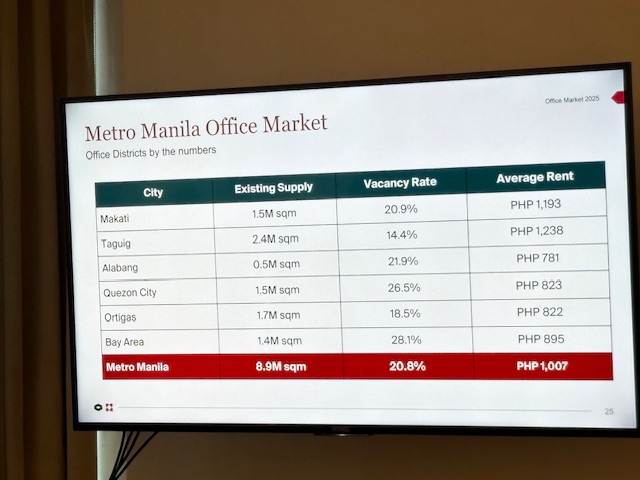
During SKF’s year-end real estate market briefing and 2026 outlook on Wednesday, Dec. 3, Senior Director Morgan McGilvray reported that Metro Manila’s office vacancy rate as of November averaged 20.8 percent out of a total existing stock of 8.9 million square meters, with an average rental rate of PHP1,007 per sqm.
Among the metro’s six major business districts, the Bay Area posted the highest vacancy at 28.1 percent of its 1.4 million sqm supply. Quezon City followed with 26.5 percent vacancy out of its 1.5 million sqm market, while Alabang ranked third with 21.9 percent vacancy across 500,000 sqm of office space.
Meanwhile, Taguig remained the most in-demand market, recording the lowest vacancy rate at 14.4 percent out of its 2.4 million sqm supply. Home to high-end developments in Bonifacio Global City, Taguig also posted the highest rental rates at PHP1,238 per sqm. Ortigas showed a relatively lower vacancy of 18.5 percent from its 1.7 million sqm stock, with average rents at PHP822 per sqm.
In Makati, the country’s premier financial district, vacancy stood at 20.9 percent across 1.5 million sqm of office supply, with an average lease rate of PHP1,193 per sqm, second only to Taguig.
With its substantial office inventory, Metro Manila ranked as the third most competitive office market in the Asia Pacific, following Kuala Lumpur and Jakarta.
McGilvray noted that IT-business process outsourcing firms continue to hold the largest share of office take-up in the country. He said around 100,000 sqm of new office space came online this year, a figure expected to double in 2026 with the completion of buildings delayed by the pandemic.
“Buildings going forward, 2026 and beyond, were probably not affected by the pandemic of 2020,” he said.
He dismissed concerns over the 20 percent vacancy rate, pointing out that the country reached a high of 40 percent during the pandemic. “It has actually been going down,” he said. By 2026, he expects vacancy to ease to the “teens.”
Vacancy surged to 30 percent during the pandemic, up from just 5 percent in 2018, but has since been slowing. McGilvray added that occupiers are increasingly relocating to “more efficient, safer and technologically advanced buildings with more features with sustainability features at its core.” Meanwhile, “the older stock left behind would be picked up by budget-conscious occupiers.”
SKF Chairman Rick Santos echoed this, saying older inventory will appeal to more cost-sensitive tenants. “This is the time for reset and repositioning,” he said.

