


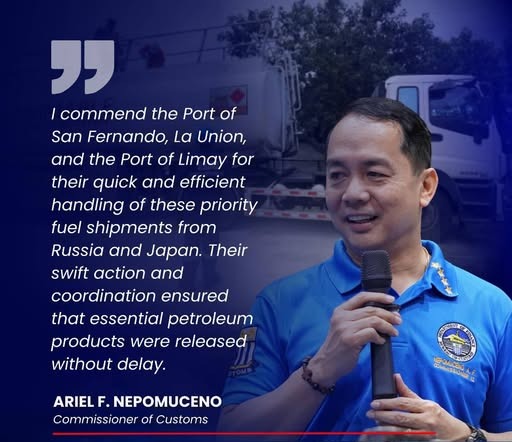
The Bureau of Customs (BOC) has reinforced its strategic measures to guarantee the steady and unhampered flow of petroleum imports nationwide. Through intensified daily monitoring and the priority processing of fuel shipments, the Bureau aims to safeguard the country’s energy requirements and stabilize the national fuel supply.
To ensure the seamless entry of essential energy resources, Customs Commissioner Ariel F. Nepomuceno issued OCOM Memo No. 36-2026 on March 23, 2026. The directive mandates all ports to implement:
-
Preferential handling and immediate unloading of petroleum imports.
-
Expedited customs processing to prevent logistical bottlenecks.
-
Enhanced inter-agency coordination and continuous real-time monitoring.
These measures were successfully executed this week during the arrival of two major shipments:
-
Port of San Fernando, La Union: The BOC facilitated the discharge of 9,157,667 liters of diesel consigned to the Philippine National Oil Company (PNOC). Arriving at the SEAOIL Bangar Terminal—the largest in Region I—this shipment is a vital component of the Department of Energy’s (DOE) Strategic Fuel Reserve program, designed to stabilize Luzon’s fuel supply.
-
Port of Limay, Bataan: Authorities prioritized the processing of 100,402.776 US barrels of ESPO Blend crude oil delivered by the M/T Sara Sky. Consigned to Petron Corporation, the cargo was unloaded at the Petron Bataan Refinery under strict BOC oversight for immediate integration into the national supply chain. “Ensuring the timely release of petroleum products is critical to keep the country moving,” stated Commissioner Ariel F. Nepomuceno. “Our goal is simple—to keep supply steady and ensure that no disruption reaches our industries or our communities. I commend the Ports of San Fernando and Limay for their swift, efficient handling of these priority shipments.”
The BOC’s facilitation efforts are backed by rigorous enforcement mechanisms to ensure all imports are genuine and tax-compliant.
-
Fuel Marking Program: In collaboration with accredited depots, the BOC continues to mark and verify fuel at the depot level. This process confirms authenticity and proper tax declarations, protecting consumers from substandard fuel and safeguarding government revenue.
-
Advanced Vessel Tracking: Utilizing a sophisticated maritime tracking system, the Bureau maintains continuous visibility of tankers as they approach Philippine jurisdiction. This allows for proactive inspections and ensures all cargoes are accounted for from offshore transit to final discharge.
In close coordination with the DOE, the BOC has strengthened real-time oversight of depot inventories nationwide. District operations have been directed to maintain accurate inventory reporting and ensure seamless coordination across all units.
Petroleum imports remain a cornerstone of national revenue, accounting for approximately ₱200 billion annually. By maintaining efficient processing and consistent import activity, the BOC ensures stable collections of excise duties while meeting the nation’s energy demands.
The Bureau of Customs remains steadfast in its mandate to balance trade facilitation with strict regulatory enforcement, ensuring that energy resources are available to the public without delay.

