


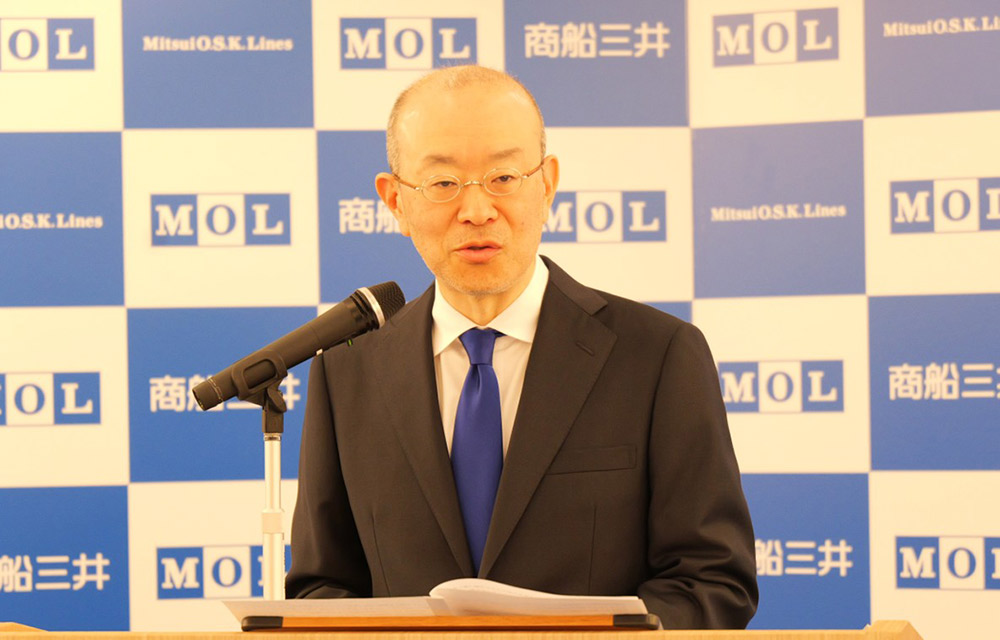
Japan’s Mitsui O.S.K. Lines, Ltd. (MOL), one of the world’s largest shipping companies, specializing in tankers, logistics, and marine transport, has made operational its Headquarters of Safety & Quality Enhancement division to maintain and enhance safety standards-not only in ship management and operational support, but also in safety management encompassing businesses beyond the shipping sector.
This was announced by Jotaro Tamura on his assumption as President & CEO of the MOL Group on April 1, 2026 during the MOL’s 142nd Anniversary celebration..
The division is part of the organizational restructuring at the MOL headquarters as it put equal emphasis on safety.
“This division will play a vital role in leading efforts to maintain and enhance safety standards-not only in ship management and operational support, but also in safety management encompassing businesses beyond the shipping sector. By working in close collaboration with our digital initiatives and aligning with the objectives of each business division, let us support frontline operations and the crews of every vessel so they can carry out their duties while enhancing safety, health, and efficiency,” said Tamura.
With the prolonged situation in Iran and the closure of the Strait of Hormuz, he assured that MOL’s topmost priority is to ensure the safety of the crews aboard its vessels.
Based on its new corporate mission, vision and value – MOL CHARTS – the new chief at MOL vowed to steadfastly pursue its 13-year long-term plan, “BLUE ACTION 2035,” while flexibly adjusting to business-unit strategies in response to changes in both the external and internal environments.
“We sustain people’s lives and ensure a prosperous future,” he said, expressing the group’s aspiration to expand business domains outward from the ocean, the core field of its shipping operations, and to enrich people’s lives in more diverse ways. This concept is directly connected to the group’s vision that redefines MOL as a “social infrastructure company.”
The initiatives advance its offshore businesses in oil, gas, and wind power that have evolved from energy transport; terminal businesses in chemical and automotive logistics, and the expansion of overseas investments in logistics and real property.
“While strengthening the competitiveness of our shipping business, we are simultaneously working to monetize new business domains and generate synergies across our portfolio. This portfolio transformation is a long-term undertaking,” Tamura added.
Financial performance
He further reported that its containership, car carrier, and chemical tanker businesses have made significant profit contributions in recent years by capturing favorable market conditions.
However, he also cited need critical responses. For instance, the dry bulk and tanker businesses may face substantial market volatility due to geopolitical developments, requiring a careful balance between providing stable transportation services and seizing advantageous opportunities. Meanwhile, the LNG and ethane carrier business must balance capturing opportunities from market expansion with improving profitability.
Group companies centered on domestic businesses-including Utoc, Daibiru, and MOL Sunflower-have generally delivered stable performance, and we anticipate their continued contribution to the Group’s overall results.
In addressing climate change, MOL will continue our initiatives with a steadfast medium- to long term perspective, while taking into account changes in the external environment-thereby demonstrating the spirit of reliability. Immediate priorities include further promoting operational efficiency to reduce CO2 emissions from our vessels and advancing business development in the transport of ammonia and liquefied CO2.
In terms of capital allocation, MOL will balance the maintenance of its financial foundation and the return of value to shareholders by moderating, to some extent, the pace of investments that it accelerated over the past three years, while improving capital efficiency through asset rotation.
To address the inherent volatility of the shipping business, he said, MOL will maintain the stability of our overall business portfolio by combining stable earnings businesses-which underpin performance even during market downturns-with a structure that enables it to capture upside when market cycles are at a high point.

