


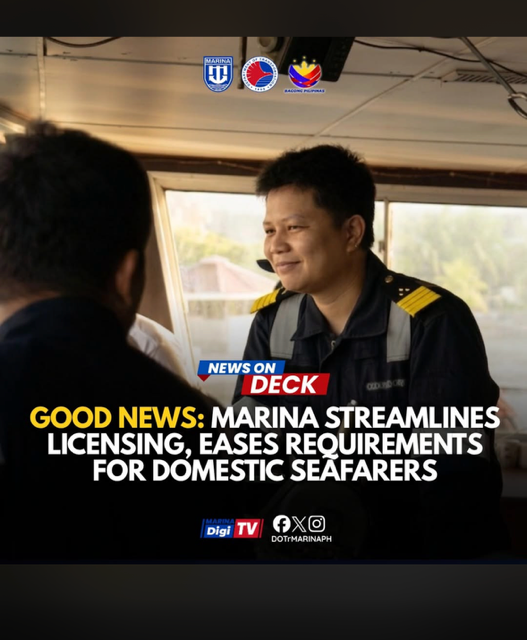
Graduates of maritime programs can now set sail on their careers without the burden of additional training, as these competencies are already embedded within their academic program, as the Maritime Industry Authority (MARINA) overhauls the country’s maritime education system by trimming down cumbersome requirements for aspiring seafarers while fortifying the nation’s domestic maritime workforce.
Anchored in the revised Memorandum Circular No. MD-2026-01, the policy covers graduates of Bachelor of Science in Marine Transportation (BSMT), Associate in Marine Transportation (AMT), or those with Certificates of Competency and Completion of Instruction (CCI) for BSMT; as well as Bachelor of Science in Marine Engineering (BSMarE), Associate in Marine Engineering (AME), or CCI for BSMarE.
The revised circular aligns with Republic Act No. 12021, or the Magna Carta of Filipino Seafarers, and prevailing maritime regulations. It sets a steadier course for the training, certification, and assessment of seafarers serving on both commercial vessels and fishing fleets.
Easier, Faster Licensing
At the same time, MARINA has eased and rationalized education and sea service requirements—clearing the passage for aspiring seafarers to qualify more efficiently, without compromising standards of competence and safety.
New policies, standards, and guidelines have also been introduced for the licensing of Major Patrons, Minor Patrons, Boat Captains, Marine Diesel Mechanics, and Motormen.
Among the most notable reforms is the replacement of the Certificate of Marine Profession (CMP) with a license ID valid for 10 years—issued without additional fees—offering both convenience and cost relief for seafarers.
The policy likewise opens new horizons for shore-based engine mechanics, who may now qualify and apply for a Motorman license, helping bolster the pool of skilled personnel onboard vessels.
Consultations
The policy was shaped through extensive consultations, technical working group deliberations, and stakeholder engagements before receiving approval from the MARINA Board.
With these reforms, MARINA aims to increase the number of qualified officers aboard Philippine-registered vessels, particularly those navigating domestic waters. More importantly, the streamlined system is expected to generate greater employment opportunities, strengthen workforce readiness, and enhance maritime safety across the archipelago.

