Low-end condo segments beat luxury market investors – LPC report
Demand in the high-end and luxury segments of the Philippine residential condominium market has declined, while lower-end segments appear more resilient and confident, showing encouraging growth despite a global fuel crisis and heightened geopolitical tensions, based on the First Quarter 2026 Philippine Market Report by property management and consultancy firm Leechiu Property Consultants (LPC).
Cautious mode
In a presentation, LPC Director for Research and Valuation Roy Golez said the high-end property market (PHP12 million to PHP68 million) is shifting to a more cautious mode.
In the first quarter this year, Golez reported that demand in this segment declined by 25 percent, tapering to 966 units compared to the previous quarter of 2025. New launches of residential units also plunged by 79 percent, translating to only 231 units in the January–March period this year. Historically, annual demand and launches for this sector ranged from 6,000 to 8,000 units, while launches typically ranged between 2,000 and 5,000 units.
Golez noted that more than 14,000 high-end units remained unsold in the first quarter, with Quezon City and Manila having among the highest concentrations of unsold inventory.
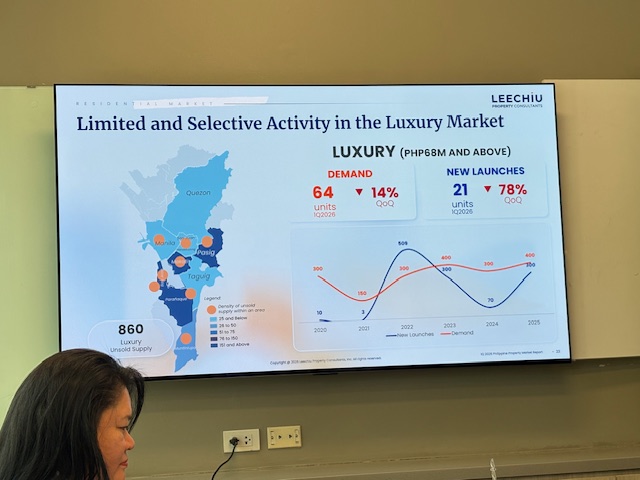
The luxury market (PHP68 million and above) suffered a 14 percent decline in demand, with only 64 units sold in the first quarter of the year. Likewise, new launches in this segment fell by 78 percent to just 21 units. This segment also posted an inventory of 860 units, mostly located in Parañaque, Pasig, and Makati.
Lower segments
Comparatively, the lower-middle (PHP1.8 million to PHP2.3 million), middle (PHP2.3 million to PHP4 million), and upper-middle (PHP4 million to PHP7 million) segments performed better.
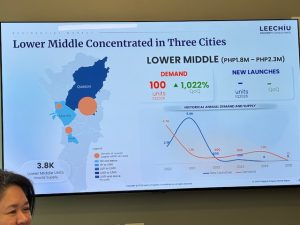
Demand in the lower-middle segment surged by 1,022 percent versus the fourth quarter of 2025, with 100 units sold in the first quarter. There were no new launches for this segment, which currently has a supply of 3,800 units.
The middle segment also posted strong growth, with demand increasing by 488 percent and 1,900 units added to supply in the first quarter.
Meanwhile, the upper-middle residential market recorded demand of 1,300 units in the first quarter, representing a 7 percent decline from the fourth quarter of 2025. This segment also added 735 units from new launches. However, it continues to show a high inventory level of 27,700 units.
Soft rents
Golez attributed the decline in demand for both high-end and luxury segments to the nature of investments in upscale residential condominium projects. These are often treated as investment instruments and account for a smaller portion of investment funds, typically allocated for future capital appreciation.
The decline can also be traced to lower yields due to softening rents. Average yields eased to 3.8 percent for the primary market and 4.6 percent for the secondary market across all locations.
“So, from last quarter’s numbers, only Makati, Ortigas have recovered. But there are really small recoveries. We’re still in the flattish range,” he pointed out.
“The Bay Area and Alabang could easily drop. So, we’re seeing here a market where investors are still slowing down. As you know, the yield for their investment is still flat, down in fact,” he said.
However, growth is being observed in the end-user market, particularly in the lower-middle to upper-middle segments.
Golez explained that, unlike the high-end and luxury segments, these market tiers cater to end-users or actual occupants of condominium units. Inventory is larger because demand is higher, albeit at lower price points. Supply growth in these segments is also driven by government initiatives aimed at addressing the housing backlog, which is largely concentrated in the socialized and lower-end categories.
Growth in the residential condominium market is expected to continue to be driven by infrastructure development, sustaining expansion outside the capital and potentially outperforming Metro Manila.
Global uncertainties are also expected to further temper near-term momentum in the Metro Manila condominium market.
- Advertisement -![spot_img]()
- Advertisement -