The Philippine economy is projected to post slower growth than earlier expected due to rising global uncertainties, particularly from the Middle East conflict and downside risks, according to the Asian Development Bank (ADB).
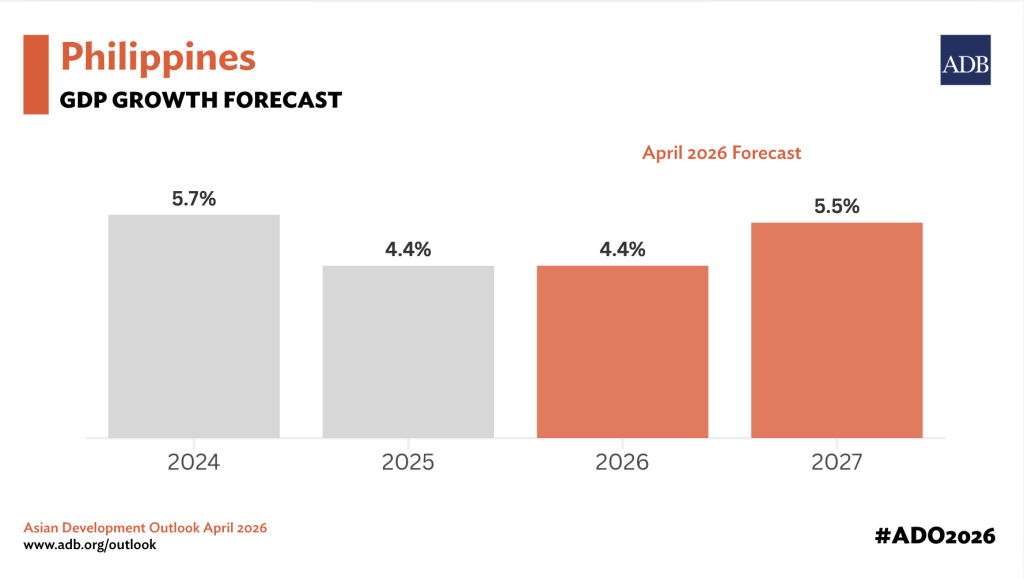
In its Asian Development Outlook (ADO) April 2026 report, the Manila-headquartered bank forecasts the country’s gross domestic product (GDP) to grow by 4.4 percent in 2026, slower than the December forecast of 5.3 percent, before rising by 5.5 percent in 2027. Growth will continue to be driven mainly by domestic demand, and with investment supported by the lagged effects of previous policy rate cuts. But the gains will be partly offset by the recent surge in price pressures, which will weigh on investment decisions and erode household spending.
“The Philippine economy, with its heavy dependence on imported fuel, will face challenges from rising external risks,” said ADB Philippines Country Director Andrew Jeffries. “What the current global conditions underscore is the need for sustained reforms especially in strengthening human capital, improving investment efficiency and the business environment, and protecting vulnerable households to ensure the country emerges unscathed and in a better growth position after the external shocks subside.”
Inflation is projected to rise to 4.0 percent in 2026, largely due to high global commodity prices, before easing to 3.5 percent in 2027, according to the report. The government has rolled out targeted assistance programs, such as cash and fuel subsidies, to cushion the impact of the Middle East conflict on vulnerable sectors such as farmers, fisherfolk and public transport drivers. It has also sought to secure more oil supplies from non-Middle East sources.
Downside risks to growth have increased, mainly from the Middle East conflict, which could further heighten inflationary pressures. Severe weather events and delays in public investment could also weigh on growth.
Private consumption is expected to grow moderately in 2026 as remittance inflows, which rose to USD35.6 billion in 2025 or equivalent to 7.3 percent of GDP, are expected to be affected by the Middle East conflict. The Middle East accounts for over 17 percent of total remittances in the Philippines, and a prolonged conflict could affect overseas Filipino workers and household income. Remittances should recover once conditions in the region improve.
Investment is projected to recover gradually as public infrastructure spending rebounds under improved budget execution and enhanced project monitoring. The 2026 national budget prioritizes health, education, workforce upskilling, social protection, agriculture infrastructure, and climate and disaster resilience.
The government’s infrastructure expenditure, along with expanded public–private partnerships, and reforms allowing greater foreign investment in key sectors—such as telecommunications, shipping, railways, and renewable energy—are expected to support medium-term growth.
The report notes that the need to strengthen inclusive, quality education and lifelong learning is a critical policy challenge in the country. Persistent learning gaps, high youth unemployment, and skills mismatches threaten the country’s ability to fully harness its demographic potential. Addressing these challenges through targeted education reforms, improved nutrition, and stronger private sector collaboration will be essential for sustaining long-term, inclusive growth.
ADB is a leading multilateral development bank supporting sustainable, inclusive, and resilient growth across Asia and the Pacific. Working with its members and partners to solve complex challenges together, ADB harnesses innovative financial tools and strategic partnerships to transform lives, build quality infrastructure, and safeguard our planet. Founded in 1966, ADB is owned by 69 members—50 from the region.