


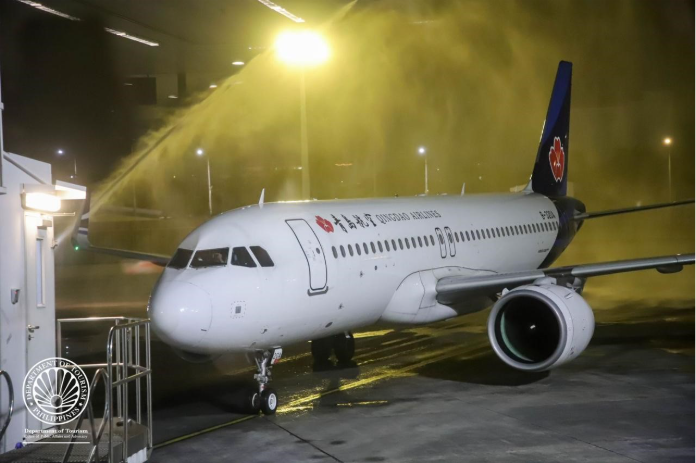
The three new direct flights by XiamenAir and Qingdao Airlines, China’s major airlines, to Manila is expected to boost connectivity and accelerate tourism recovery in the country.
XiamenAir launched its inaugural Hangzhou–Manila service on May 20, marking another milestone in the continued expansion of air connectivity between the Philippines and China. The route, including return flights from Manila to Hangzhou, will operate four times weekly—every Monday, Wednesday, Friday, and Sunday—until October 31, 2026.
The inaugural Hangzhou–Manila flight arrived with 76 passengers onboard, while the outbound Manila–Hangzhou service departed carrying 122 passengers. The route connects Manila to one of China’s leading centers for innovation and technology and is expected to support not only tourism exchanges but also business and investment opportunities.
On May 16, Qingdao Airlines launched its inaugural Changsha–Manila route, followed by XiamenAir’s inaugural Chongqing–Manila service on May 21.
Qingdao Airlines’ maiden Changsha–Manila flight arrived in Manila carrying 56 passengers, while the outbound Manila–Changsha service departed with 170 passengers onboard. The route will operate every Tuesday, Thursday, and Saturday until October 24, 2026.
Changsha, the capital of Hunan Province, is known for its rich history, cultural attractions, and distinctive cuisine, providing the Philippines greater access to travelers from central China.
Meanwhile, XiamenAir’s inaugural Chongqing–Manila flight arrived at Ninoy Aquino International Airport (NAIA) carrying 74 passengers, while the outbound service departed with 97 passengers. Flights will operate every Tuesday, Thursday, and Sunday until October 31, 2026.
One of China’s largest metropolitan centers, Chongqing is recognized for its multilayered urban landscape, modern infrastructure, and rapidly expanding consumer market.
The DOT noted that the Chongqing service marks the 33rd direct international route launched to the Philippines since the beginning of 2025, underscoring continued growth in international connectivity.
Tourism Secretary Dita Angara-Mathay said the continued expansion of direct connectivity reflects the government’s broader strategy to accelerate recovery in the Chinese market and unlock greater tourism growth opportunities.
China remained among the Philippines’ leading source markets in 2025, accounting for 4.56 percent of total visitor arrivals.
Beyond China, the Philippines has also expanded international connectivity through new and resumed routes linking Manila and Cebu with destinations including San Francisco, Seattle, Vancouver, and Paris.
Across Asia, expanded connections now serve key markets such as Japan, South Korea, Taiwan, Hong Kong, Vietnam, Singapore, and Thailand, with international flights reaching not only Manila but also Cebu, Clark, Iloilo, Bohol, Kalibo, Caticlan, and Davao.
From January 1 to May 19, 2026, the Philippines recorded 7,779,012 international air seats for direct inbound flights, reflecting an 8.31 percent increase compared with the same period in 2025.
For the same period, the Philippines also recorded 30,729 international flight arrivals, representing a 4.71 percent increase from the same period in 2025—another indicator of sustained momentum across the country’s aviation and tourism sectors.

