


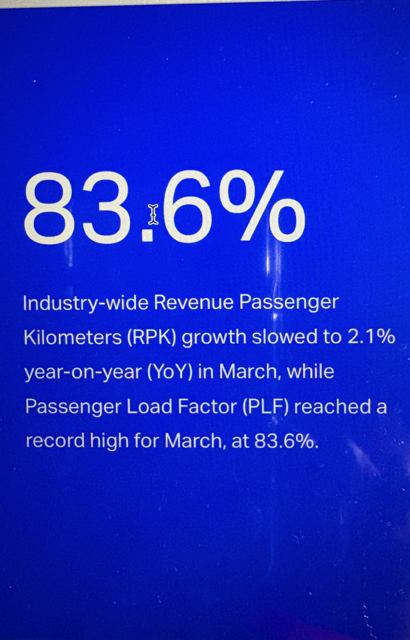
Despite travel disruption, total global air passenger demand still managed to grow in March but the sharp 60 percent decline by carriers in the Middle East tempered the growth to a modest 2.1 percent in March compared to the same month last year, the International Air Transport Association (IATA) reported.
In its Passenger Market Analysis – March 2026 released on April 29, IATA said that total airline capacity, measured in available seat kilometers (ASK), decreased 1.7 percent year-on-year while the load factor was at record high of 83.6 percent in March.
International demand though fell 0.6 percent compared to March 2025. Capacity was down -6.2 percent year-on-year, and the load factor was 84.1 percent (+4.7 ppt compared to March 2025). The overall decline in international traffic was led by a -60.8 percent fall in traffic by carriers in the Middle East.
Domestic demand increased 6.5 percent compared to March 2025. Capacity increased 5.6 percent year-on-year. The load factor was 83.0 percent (+0.7 ppt compared to March 2025).
As Middle Easter carriers contracted by more than half, airlines from others regions such broadly maintained or saw accelerated growth.
Domestic traffic growth accelerated slightly in March, supported by double-digit expansions in the Chinese and Brazilian domestic markets, IATA said.
IATA also forecast that global scheduled seat capacity is expected to return to growth in May, following the contraction observed in April.

