


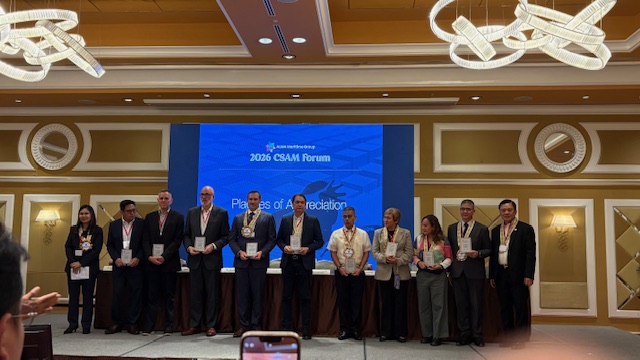
Philippine ship manning agencies, together with the U.S. Embassy in Manila, cruise ship operators, and concerned government agencies, have vowed zero tolerance for online child sexual abuse materials (CSAM) while continuing efforts to safeguard the welfare of Filipino seafarers.
Capt. Antonio Ladera, president of the Association of Licensed Manning Agencies (ALMA), said during a specialized industry forum on CSAM on Tuesday that there has been a significant increase in the number of Filipino seafarers denied entry into U.S. ports.
By mid-2025, data showed that nearly 100 Filipino seafarers had already been deported. More recently, 26 Filipino seafarers were arrested and deported following inspections in San Diego.
The violations involved the possession and distribution of CSAM, a grave criminal offense under both Philippine and U.S. laws. A single prohibited file found on a smartphone can lead to immediate visa revocation and deportation, effectively ruining a seafarer’s future career prospects.
“These are not just numbers. These are careers built over decades to have been ended in an instant. These are families whose breadwinners now face a permanent lifetime ban from entering the United States,” Ladera said.
“Our industry is moving towards a proactive, zero-tolerance framework,” Ladera said, adding that ALMA’s strategy is built on three pillars of digital compliance.
The first pillar is enhanced vetting and screening. ALMA members, he said, must strengthen recruitment processes to ensure they deploy individuals who uphold the highest standards of conduct.
The second pillar is mandatory education. Manning agencies, he said, must ensure that no seafarer boards a vessel without receiving a clear and unequivocal briefing on CSAM. Seafarers must understand that digital records include everything from downloaded videos to messages shared in private groups online.
The third pillar is proactive welfare support. ALMA is working with shipowners and cruise lines to harmonize messaging and provide seafarers access to counseling and onboard policies that promote a healthy and professional digital environment during long deployments.
“We are not here to be critical of the security measures of our host ports. Rather, we are here to ensure that the Filipino seafarers are the most compliant, most informed, and most professional in the world,” Ladera said.
The forum also marked the launch of an industry-wide advocacy campaign guided by the directive of the U.S. Embassy and formalized through ALMA Memorandum No. 2026-02 to combat CSAM.
In his keynote speech, U.S. Embassy Manila Visa Chief Robert Romanowski, speaking on “Strengthening International Cooperation Against CSAM,” underscored that U.S. authorities strictly enforce laws on CSAM and that offenders will be held accountable.
“There are no exceptions,” he said.
Romanowski, who shared that he came from a maritime village in Cape Cod on the eastern seaboard, about 70 miles from Boston, noted that Filipino seafarers underpin much of the world’s maritime workforce.
He added that the U.S. Embassy is doing its best to facilitate and support the domestic maritime industry. As visa chief in Manila, Romanowski said the embassy’s consular office processes more seafarer visas than any other U.S. embassy in the world.
“Seafarers must understand that viewing, possessing, or sharing CSAM has serious consequences. And this includes joining online chat groups where these images are shared because behind every image of a child being sexually abused is a real child who has been victimized. These aren’t just files on a phone. They document actual crimes against real children,” he said.
Romanowski added that U.S. authorities are committed to working with manning agencies, cruise lines, and the Philippine government to protect children and ensure Filipino seafarers understand these laws and their consequences before boarding vessels.
Presentations by some of the country’s leading suppliers of seafarers to cruise ships echoed the same zero-tolerance policy against CSAM and its perpetrators. Cruise ships have been targeted because some families go cruising with children, unlike regular cargo ships.
Arnold Javier, president of Magsaysay Maritime Corp., documented incidents involving Filipino seafarers accused of CSAM-related violations. He said the first incident was reported in May 2024, followed by a sharp rise in deportation cases last year amid stricter U.S. border enforcement in several ports.
The latest case, reported in April this year, involved 26 Filipino seafarers working on cruise ships who were detained and deported back to the Philippines. Many of them claimed they were “framed” or deported without formal charges.
Javier said Magsaysay Maritime has incorporated CSAM awareness into its training and pre-departure seminars, emphasizing digital responsibility among seafarers.
He warned that U.S. authorities conduct forensic examinations that can trace a person’s digital history, not just search electronic devices for prohibited content.
“Your digital footprint travels with you,” Javier said.
Katherine Avelino, senior vice president for Cruise Operations at Philippine Transmarine Carriers Inc., said the company is strengthening its orientation programs to ensure seafarers act responsibly both online and offline.
“This is not about compliance with the law, but protecting the children from such illegal acts,” she said.
Avelino added that PTC maintains a zero-tolerance policy against CSAM and promotes accountability by requiring seafarers to observe cyber ethics and exercise responsible behavior on social media. Seafarers are also required to report suspicious activities onboard ships.
Richard Brearly, Vice-President II for Crew and Travel Operations at Carnival Cruise Line, cited education as a critical component in the fight against CSAM, saying it would help Filipino seafarers continue to be regarded as among the best in the world.
On the government side, Department of Migrant Workers Undersecretary Bernard Olalia said in his keynote speech that the government is addressing the issue with clarity and vigilance, emphasizing that the reputation of Filipino seafarers and the country’s standing as a seafaring nation must be protected.
Calling CSAM a critical concern, Olalia said the DMW would include CSAM awareness as an important component of pre-departure orientation seminars to ensure seafarers are fully informed about the legal environments in which they work.
He also vowed that the DMW would work closely with manning agencies and cruise ship operators.

