


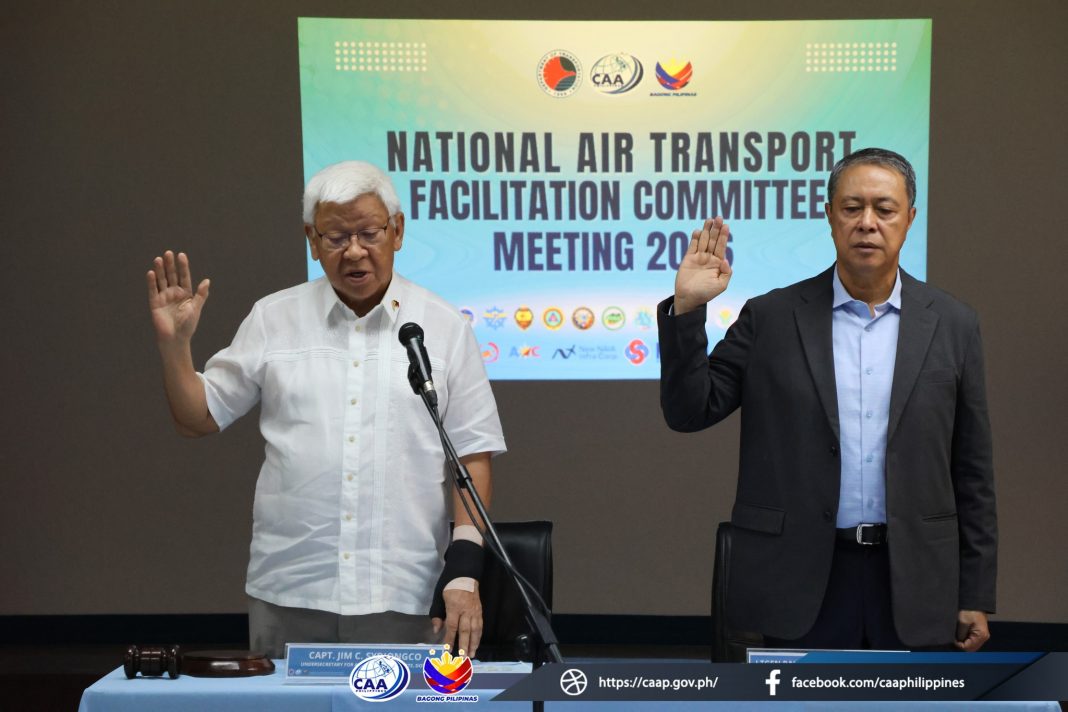
The Civil Aviation Authority of the Philippines (CAAP) hosted the meeting of the National Air Transport Facilitation Committee (NATFC) on Tuesday, May 12, at the Civil Aviation Training Center in Pasay City.
The high-level convention brought together committee members from various government agencies, aircraft operators, and airport stakeholders to advance the country’s aviation frameworks.
The convening of the NATFC directly strengthens the Philippines’ compliance with the International Civil Aviation Organization’s (ICAO) Annex 9 – Facilitation. This global standard mandates member states to establish national mechanisms that promote seamless air transport operations while simultaneously upholding robust aviation security, border integrity, and public health safeguards.
As the country’s primary inter-agency platform, the NATFC is tasked with addressing critical facilitation concerns across Philippine airports equipped with border control measures.
During the assembly, CAAP Director General, Retired Lt. Gen. Raul del Rosario, emphasized the vital equilibrium required in modern aviation management.
“This meeting provides a platform to address concerns on border control procedures, including immigration, customs, quarantine, and related controls, while ensuring security protocols remain upheld,” said DG Del Rosario. “As we pursue more efficient passenger processing and seamless airport operations, we must maintain the balance between facilitation and security.”
DG Del Rosario also advocated for expanding these standards, stressing the need to replicate facilitation mechanisms at airports without traditional border controls—such as immigration and customs—by adapting relevant domestic protocols for quarantine, health, and related controls.
A major focus of the meeting was formalizing the committee’s organizational structure and kickstarting the development of the National Air Transport Facilitation Program. This upcoming framework will serve as the definitive blueprint for implementing ICAO Annex 9 facilitation measures nationwide.
Aligning with the strategic directives of President Ferdinand Marcos Jr. and Transportation Secretary Giovanni Lopez, Department of Transportation (DOTr) Undersecretary for Aviation and Airports Jim Sydiongco called for heightened collaboration and modernization across the sector.
“We must improve our policies, systems, infrastructure, and operations to meet global demands and the growing expectations of the traveling public,” stated Usec Sydiongco. “Our goal is to create a safer, more seamless, efficient, and passenger-centered travel environment for every Filipino and traveler passing through our gateways.”
The NATFC’s strategic oversight spans a vast network of gateways. Beyond major privatized international hubs like Ninoy Aquino International Airport (NAIA), Mactan-Cebu, Clark, Bohol-Panglao, and Laguindingan, CAAP directly manages and operates:
-
5 additional airports handling international flights
-
34 Class 1 and Class 2 commercial airports
-
33 community airports
Through the synchronization of the NATFC, the Philippine government reaffirms its commitment to elevating the standard of national air travel, ensuring it remains secure, efficient, and globally competitive.

