


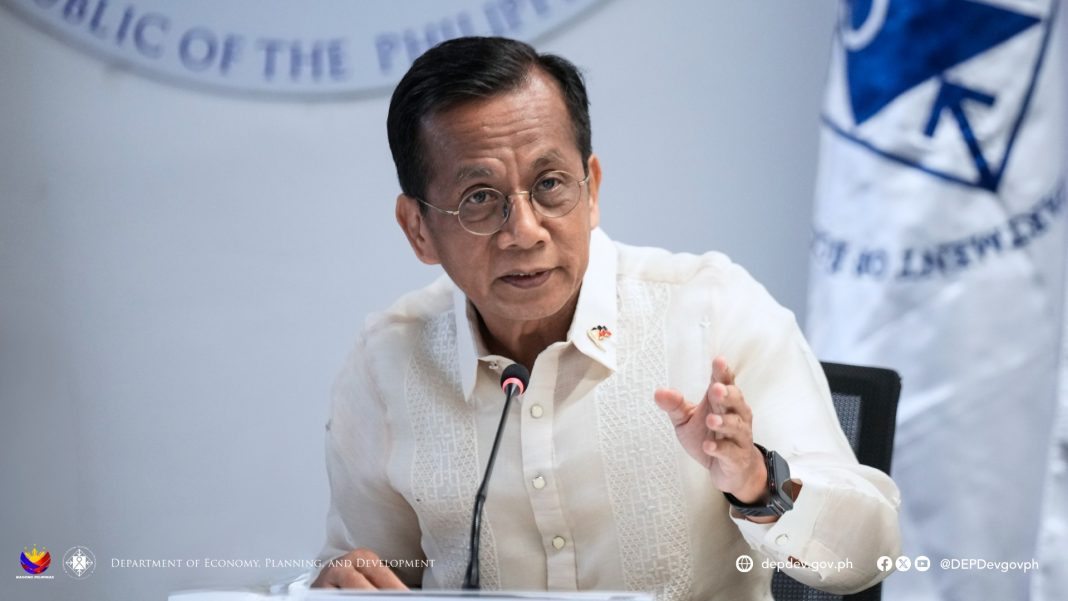
Department of Economy, Planning and Development (DEPDev) Secretary Arsenio Balisacan urged a balanced perspective on the country’s economic trajectory, stating that while the Philippines’ official elevation to an Upper-Middle Income Country by the World Bank is a monumental milestone, the government remains fiercely focused on navigating a complex economic landscape in 2026.
The World Bank’s recent reclassification marks the end of the Philippines’ 39-year tenure as a lower-middle-income economy. Driven by a robust 5.8 percent average annual growth from 2021 to 2025, the country’s gross national income (GNI) per capita reached US$4,850 in 2025, officially crossing the World Bank’s threshold.
“This milestone reflects the country’s economic performance through 2025. It is the result of years of sound macroeconomic management, important structural reforms, and the resilience, industry, and hard work of the Filipino people,” Balisacan said.
However, Sec. Balisacan emphasized that average income metrics do not signal the end of the nation’s development journey. “Upper-middle-income status is not our destination,” Balisacan clarified. “Development is measured by whether growth creates quality jobs, raises productivity, expands opportunities, reduces poverty, and improves the quality of life of our people.”
Secretary Balisacan presented a nuanced look at the first half of 2026, acknowledging that domestic and external shocks have tested the economy’s resilience:
-
Domestic Challenges: The lagged effects of late-2025 economic shifts dampened local business and consumer confidence, which coincided with a noticeable slowdown in public infrastructure spending.
-
External Pressures: Escalating conflicts in the Middle East drove a sharp increase in global oil prices. As a net energy importer, the Philippines absorbed higher transport and production costs, accelerating inflation and straining household budgets during the first half of the year.
“Employment remained relatively stable. But many Filipino families understandably felt the burden of higher prices, while businesses became more cautious amid heightened uncertainty,” Balisacan noted, adding that these realities form the foundation of current policy adjustments.
To restore momentum and protect Filipino households, DEPDev outlined four interconnected pillars of focus for the remainder of the year:
-
Accelerating Growth and Infrastructure: Fast-tracking strategic public infrastructure and high-impact investments to stimulate economic activity, improve connectivity, and generate quality employment, while actively encouraging private sector participation.
-
Mitigating Inflation and Enhancing Resilience: Collaborative efforts across the economic team to maintain price stability, secure food and energy supplies, and invest in climate-resilient infrastructure like irrigation, water resources, and disaster preparedness.
-
Boosting Long-Term Productivity: Channeling sustained investments into health, education, digital transformation, and workforce skills to prepare the Filipino labor market for higher-value industries.
-
Institutional Strengthening: Enhancing transparent governance, efficient regulation, and a predictable business environment to sustain investor confidence and ensure inclusive economic growth.
Balisacan reaffirmed DEPDev’s commitment to evidence-based, forward-looking policy adjustments, pledging close collaboration with local governments, the private sector, civil society, and Congress.
“Our task now is to restore a higher and more sustainable growth path—one that is underpinned by rising productivity and innovation, resilient to shocks, and expands opportunities for every Filipino to participate in, contribute to, and benefit from economic progress,” Balisacan concluded.

