


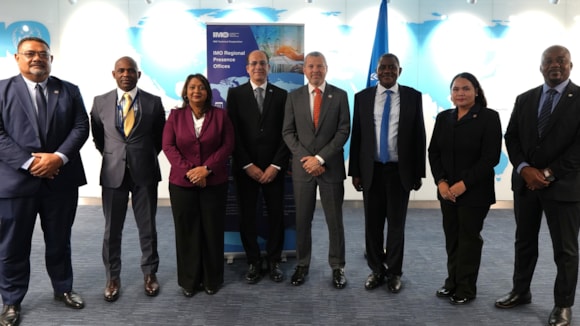
The International Maritime Organization (IMO) has deployed its full team of regional coordinators across seven regional presence offices (RPOs) worldwide.
This strategic expansion marks a major shift in how the IMO delivers technical cooperation, shifting from traditional outpost management to active, field-led regional leadership.
The newly completed team will provide direct, tailored support to member states, with a dedicated focus on the urgent needs and priorities of Least Developed Countries (LDCs) and Small Island Developing States (SIDS).
IMO Secretary-General Mr. Arsenio Dominguez welcomed the team during their first joint summit in London, stating: “Regional Presence Offices are no longer simply outposts of the Organization; they are the face of IMO in the field and the bridge between our global priorities and the realities of our Member States.”
The seven RPOs strategically cover the following critical maritime regions:
-
Africa: Eastern and Southern Africa; West and Central Africa (Anglophone); West and Central Africa (Francophone)
-
Americas & Pacific: The Caribbean; The Pacific
-
Asia & Middle East: East Asia; Middle East and North Africa
To maximize local impact, the Regional Coordinators will oversee and harmonize IMO activities across 11 core thematic areas tied directly to the IMO’s Technical Cooperation Programme:
| Safety & Security | Maritime Safety • Maritime Security |
| Environment & Climate | Marine Environment • Climate Action • Ocean Governance |
| Governance & Trade | Facilitation and Trade • Law and Governance • IMSAS Compliance |
| Growth & Capacity | Gender Equality • Education and Training • Partnership Outreach |
The full team recently convened at the IMO Headquarters in London to align on strategies for the upcoming cycle. A major focal point of the transition is the rollout of new digital tools—specifically the Technical Cooperation Portal and Dashboard. These platforms are designed to modernize how the IMO tracks regional needs, ensuring greater transparency, faster response times, and data-driven delivery of maritime support.
By anchoring these coordinators directly within their respective regions, the IMO aims to accelerate compliance with international maritime standards while fostering sustainable, local ocean economies.

