The Philippines continues to hold its position as the world’s leading supplier of seafarers, cementing its critical role in keeping the global merchant fleet moving with highly skilled maritime professionals amid shortage in supply of seafarers globally.
According to the newly released Seafarer Workforce Report 2026, co-authored by the Baltic and International Maritime Council (BIMCO) and the International Chamber of Shipping (ICS), the Philippines ranks first among the world’s five largest seafarer-supplying nations.
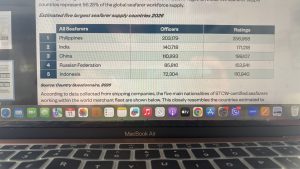
The benchmark report, published once every five years, estimates that the Philippines provides a massive share of the global maritime workforce, including:
-
203,179 Officers
-
256,968 Ratings
Rounding out the top five global suppliers are India, China, the Russian Federation, and Indonesia. Together, these five nations account for 56.25% of the total global seafarer workforce.
Specifically, the Philippines bested the four other seafarer country suppliers in both officers and ratings. Data showed there are 203,179 Filipino officers manning global merchant ships and 256,968 ratings.
India followed with 140,718 officers and 171,218 ratings, while China supplies 110,893 officers and 199,107 ratings. The Russian Federation has a total of 85,816 officers and 153,541 ratings and Indonesia with 72,304 officers and 110,940 ratings.
Furthermore, data pulled directly from international shipping companies confirms that Filipinos remain the dominant nationality among STCW-certified (Standards of Training, Certification, and Watchkeeping) crew members serving aboard merchant ships, leading in both officer and rating categories. Other top nationalities serving the fleet include Ukrainians, Indians, Romanians, and Poles.
In response to these findings, the Maritime Industry Authority (MARINA) reiterated its commitment to upholding the high standards that keep Filipino maritime professionals ahead of the curve. MARINA continues to roll out aggressive reforms across the country’s maritime education, training, assessment, and certification systems. These initiatives are designed to ensure full compliance with strict international standards while addressing the evolving technological and competency needs of the modern shipping industry.
The 2026 report’s findings stand as a strong testament to the enduring trust, demand, and respect that international shipping companies place in the competence and professionalism of Filipino seafarers.
Shortage of seafarers globally
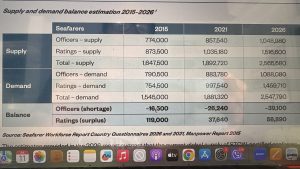
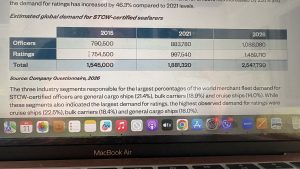
For context, the global supply of seafarers in 2026 is estimated at 2,565,580 seafarers, of which 1,048,980 are officers and 1,516,600 are ratings.
The report also placed the current supply-demand situation for the global seafarer workforce at a shortage of 39,100 officers and a surplus of 56,890 ratings.
Notably, the shortage in the supply of officers has worsened to 39,100 in 2026 from 16,500 in 2015 and 26,240 in 2021.
Meanwhile, there has been an increasing number of ratings to 56,890
Since the 2021 report, the supply of STCW-certified seafarers available to the internationally trading world merchant fleet has increased, with both numbers of qualified officers and ratings continuing to grow. The number of STCW-certified officers is now estimated at 1,048,980, a percentage increase of about 22 percent since 2021.
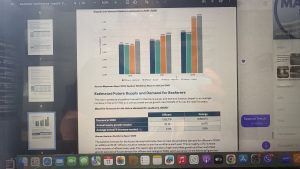
Meanwhile, the report estimates an 47 percent increase in the number of STCW-certified ratings since 2021. According to estimates of national contributions to the current global supply of seafarers, the five countries reporting the largest numbers of seafarers in 2026 are shown below. Together, these five seafarer supply countries represent 56.25 percentage t of the global seafarer workforce supply.
Growth forecast
The baseline forecast for the future demand estimates an annual 2 percent increase in the number of officers globally.
To meet the predicted demand for officers in 2030, the report said an additional 22,747 officers would be needed to join the workforce each year. The report also provides a ‘high’ world fleet growth and ‘low’ world fleet growth estimate of future demand for officers and ratings in 2030.
To support the growth in demand, the report said that levels and quality of available training, coupled with trends in recruitment and seafarer retention, are vital in influencing the supply-demand balance of the global seafarer workforce. This report finds that the number of officer cadets has increased since the 2021 report, further building on the increase of officer trainees observed from 2015 to 2021.
The ratio of officer cadets to qualified officers in 2026 is now 1:3.8, up from both 1:4.8 in 2021 and 1:7.6 in 2015.
When recruiting STCW-certified officers, companies reported the highest level of difficulty in hiring engineering officers and deck officers, while noting that it is easier to recruit ratings to work both on the deck and in the engine room. Additionally, the report also finds that it is becoming easier to find officer cadet berths, building on a trend of increased berth availability first reported in the 2015 report.
However, compared to officer cadets, it is even easier for rating trainees to obtain a berth, with almost two-thirds of respondents reporting that it is easy or very easy to find a berth for rating trainees. The growth in demand for both ratings and officers is likely being driven by the expansion of the global merchant fleet.
As the COVID-19 pandemic restrictions eased since 2021, the demand for ratings in particular reported a sharp increase as the sector returned to pre-COVID-19 levels. Overall, the recruitment outlook over the last five years has produced K-shaped results as the shortage of officers has widened with demand while the surplus of ratings has also increased, tempering ratings demand.
As the predicted demand for officers will require continued high intakes of STCW-certified officers, the report recommended that it is essential for maritime education and training and careers at sea are promoted with information on transitioning to shore-based roles.
It further recommended that levels of seafarer recruitment and retention are regularly and closely monitored by maritime administrations to inform the industry and policymakers of the global supply and demand situation of the seafarer workforce.