


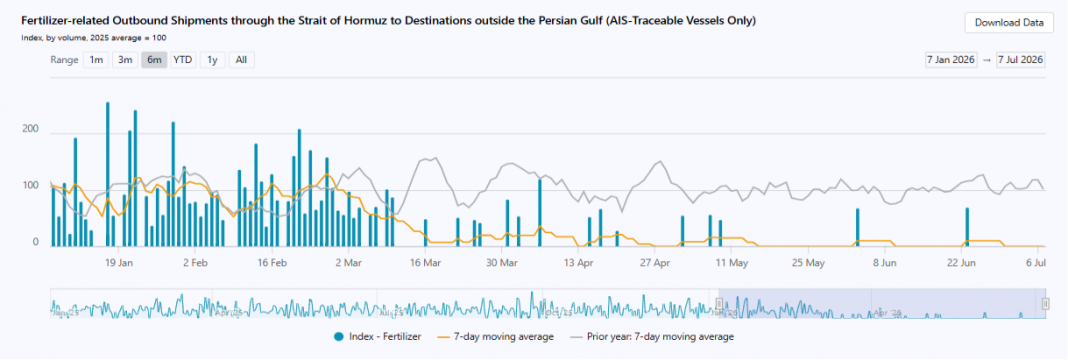
A new data analysis released by the WTO Secretariat reveals that the conflict in the Persian Gulf has severely disrupted global trade in urea and phosphate fertilizers.
The disruption has triggered sharp price spikes and raised serious concerns over agricultural yields, food prices, and global food security, with certain economies in Africa and Asia identified as particularly vulnerable to the resulting shortages.
However, recent progress toward reopening the Strait of Hormuz—a vital maritime channelling for global fertilizer shipments—is expected to ease trade frictions and gradually restore stability to international markets.
Key findings from the analysis:
-
Supply Shock: The Gulf region is a cornerstone of the global agricultural supply chain, accounting for 24.8% of global nitrogenous fertilizer exports and 11.4% of phosphatic fertilizer exports.
-
Regional Impact: Asian economies are heavily reliant on this region, absorbing 40% of the Gulf’s nitrogenous fertilizer exports and nearly half (48%) of its phosphatic exports.
-
Price Volatility: Following the outbreak of the conflict in February 2026, fertilizer prices experienced dramatic surges:
-
Urea prices doubled from approximately US$ 400 per metric ton (mt) to over US$ 850/mt in April 2026, before correcting to US$ 453/mt in June.
-
Diammonium phosphate (DAP) prices climbed substantially from US$ 580/mt to around US$ 770/mt.
-
-
Historical Context: While severe, the recent price spikes remain below the record peaks of 2022 following the outbreak of the war in Ukraine, where urea surpassed US$ 900/mt and DAP approached US$ 960/mt.
Fertilizers are critical inputs for global food production, requiring distinct manufacturing processes and supply chains:
| Fertilizer Type / Input | Primary Agricultural Role | Market Vulnerability |
| Nitrogen (e.g., Urea) | Drives vegetative plant growth. | Highly sensitive to energy markets; production relies on natural gas as feedstock and fuel. |
| Phosphorus & Potassium | Supports root development, reproduction, and overall plant health. | Dependent on localized mining activities; production is highly concentrated in a few economies (e.g., Russia, China, Morocco). |
| Sulphur | Vital secondary nutrient. | A pivotal component required for manufacturing phosphate fertilizers. |
The WTO Secretariat emphasizes that the trajectory of global food and fertilizer prices will heavily depend on the successful implementation of agreements to reopen trade through the Strait of Hormuz. Restoring secure trade routes is paramount to stabilizing the market, protecting crop yields, and insulated vulnerable economies from compounding food security crises.

