


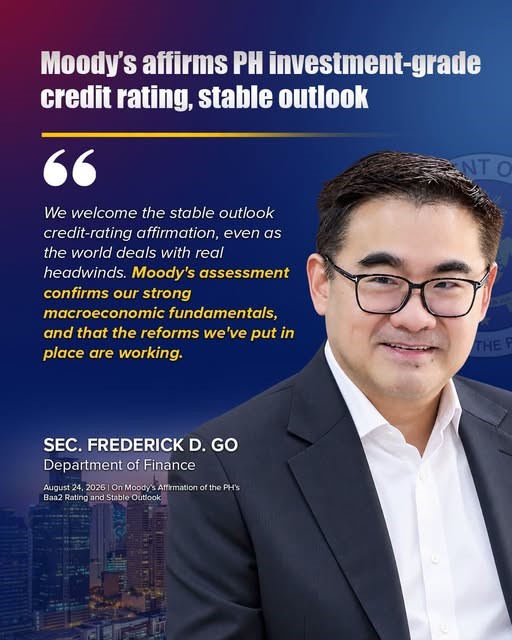
Moody’s Ratings has affirmed the Philippines’ Baa2 investment-grade credit rating and maintained its stable outlook, reinforcing the nation’s steady economic standing amidst global economic challenges, rising energy costs, and temporary shifts in public infrastructure spending.
The rating affirmation reflects the robust underlying fundamentals of the Philippine economy. Moody’s highlighted the country’s reliable access to domestic and international funding markets, along with ample foreign-currency reserves designed to navigate global capital market volatility. The rating agency anticipates that the nation’s fiscal metrics will stabilize over the coming two years, bolstered by a steady economic recovery and the government’s ongoing dedication to fiscal consolidation.
“We welcome the stable outlook credit-rating affirmation, even as the world deals with real headwinds. Moody’s assessment confirms our strong macroeconomic fundamentals, and that the reforms we’ve put in place are working,” stated Finance Secretary Frederick D. Go.
Moody’s noted that the Marcos, Jr. administration’s economic reforms—including the CREATE MORE Act, the liberalization of sectors like renewable energy, and expanded private sector participation—are projected to drive higher investments and productivity moving forward.
Regarding fiscal management, Moody’s confirmed that consolidation efforts remain on track, with expectations for the fiscal deficit to narrow to 3.9% of GDP in 2026, down from 4.3% in 2024. Additionally, the Bureau of the Treasury’s proactive liability management, which includes extending debt maturities and sustaining a predominantly fixed-rate, local-currency-denominated portfolio, continues to safeguard the sovereign debt against high refinancing costs and interest rate fluctuations.
Moving forward, the administration remains committed to strengthening revenue mobilization, enhancing public expenditure efficiency, and advancing structural reforms that champion investment-led, inclusive growth.

