


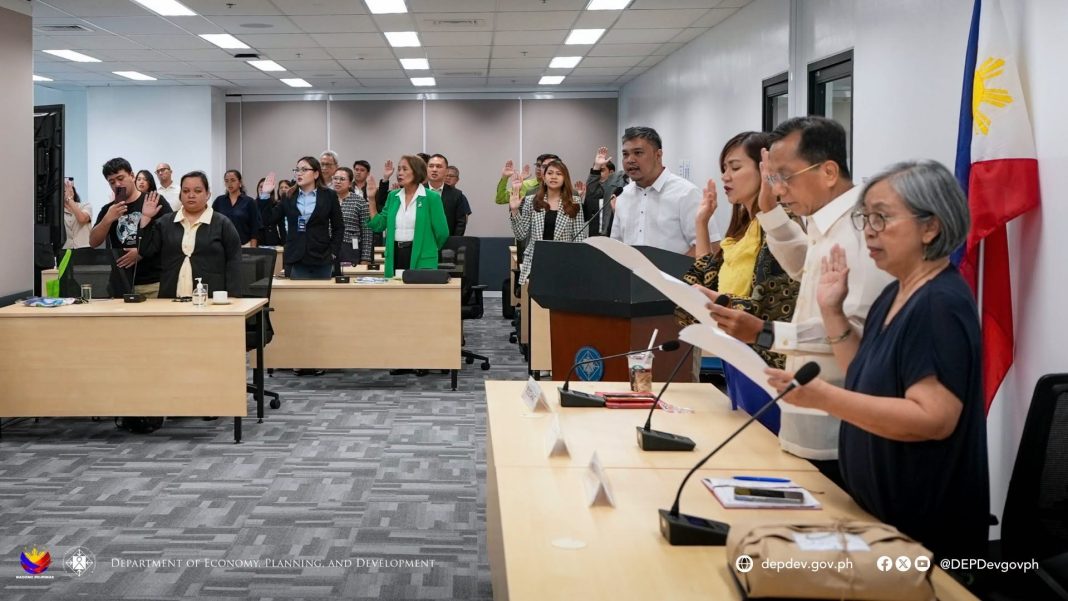
In a major push to accelerate the country’s progress toward the United Nations 2030 Agenda, Department of Economy, Planning, and Development (DEPDev) Secretary Arsenio M. Balisacan administered the ceremonial oathtaking of the newly appointed members of the Stakeholders’ Chamber on the Sustainable Development Goals (SDGs) at the DEPDev Central Office in Mandaluyong City.
The newly inducted roster expands the platform to include representatives from 72 non-government organizations (NGOs) and vulnerable sector groups from across the country.
As the Philippines’ first institutionalized multi-stakeholder platform for sustainable development, the Chamber was established by the national government to bring together the private sector, civil society, and academia. Its primary objective is to build strategic partnerships that advance the country’s performance across all 17 SDGs.
“The Sustainable Development Goals cannot be achieved by government action alone,” Secretary Balisacan emphasized. “By bringing our civil society partners, non-government organizations, and vulnerable sector representatives directly into the governance process, we ensure that our national development strategy remains inclusive, accountable, and deeply rooted in the needs of every Filipino.”
The Stakeholders’ Chamber serves a vital role within the national policy architecture. DEPDev chairs and acts as the Secretariat for the Subcommittee on SDGs (SC-SDG) under the Development Budget Coordination Committee (DBCC).
Since its establishment in 2022, the Chamber has collaborated closely with national agencies on various SDG-related initiatives. It bridges government priorities with non-state actions by aligning outreach, policy recommendations, and localized advocacy with its members’ respective corporate social responsibility (CSR) and sustainability initiatives.
To ensure targeted action, Chamber members operate across five specialized thematic areas:
-
Social: Focuses on human development, education, and health equity.
-
Economic: Drives inclusive growth, sustainable livelihoods, and innovation.
-
Environment: Directs efforts toward climate action, biodiversity, and clean energy.
-
Peace: Addresses institutional governance, justice, and social cohesion.
-
Monitoring: Evaluates data integrity and tracks real-world progress across indicators.
Through these technical working groups, members are empowered to provide direct, critical feedback on key national assessments, including the Voluntary National Review (VNR), ensuring that ground-level realities guide national policy decision-making.

