


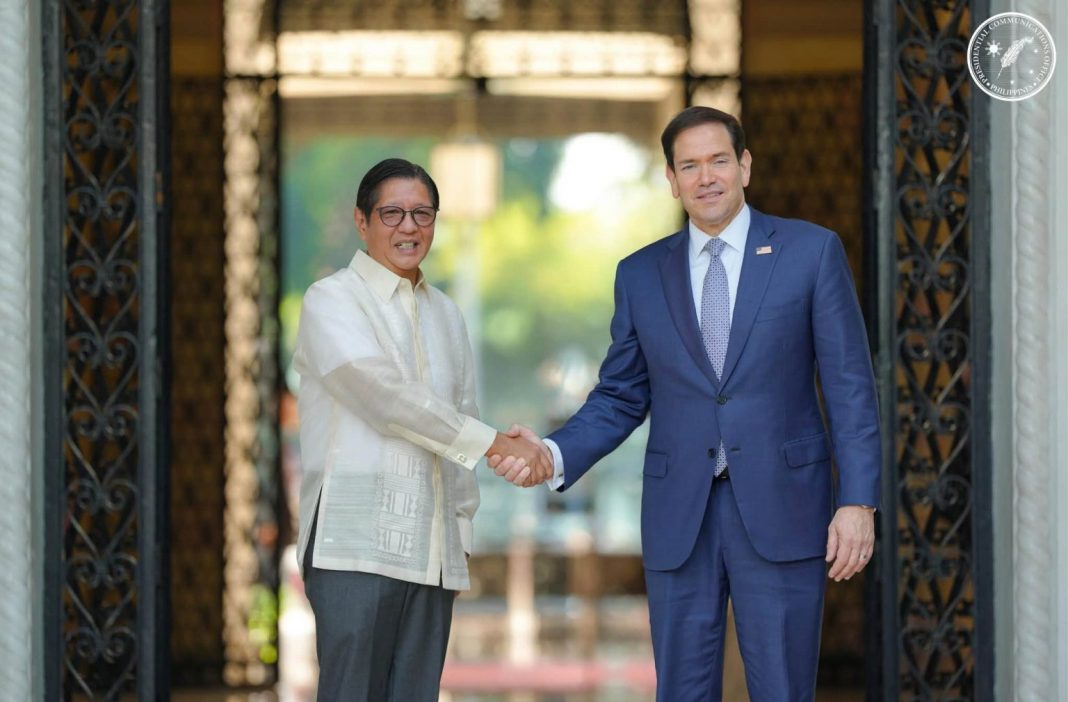
President Ferdinand R. Marcos Jr. and United States Secretary of State Marco Rubio met at Malacañang Palace to reaffirm the enduring Philippines–U.S. alliance and agree on concrete steps to deepen bilateral collaboration across emerging technologies, regional defense, trade, and global crisis response.
The bilateral meeting coincided with the Association of Southeast Asian Nations (ASEAN) Foreign Ministers Meetings hosted in Manila, as well as the historic 80th anniversary of formal diplomatic relations between the two nations, established on July 4, 1946.
During the courtesy call—Secretary Rubio’s first official visit to the Philippines in his role as U.S. Secretary of State—both leaders outlined critical focus areas to navigate evolving geopolitical and economic challenges:
-
Defense & Regional Stability: Reaffirming commitments under the Mutual Defense Treaty (MDT), Visiting Forces Agreement (VFA), and Enhanced Defense Cooperation Agreement (EDCA) to maintain peace and stability in the Indo-Pacific.
-
Emerging Technologies: Initiating joint efforts on cutting-edge innovations, including artificial intelligence (AI) and digital infrastructure.
-
Global & Regional Crisis Response: Coordinating strategies to mitigate the economic and humanitarian impacts of the ongoing Middle East conflict and enhancing joint disaster response capabilities.
-
Economic Integration: Expanding trade, investment, and bilateral business partnerships to build supply chain resilience. “I am very glad that you have had this opportunity to engage and exchange views with other foreign ministers, especially coming out of ASEAN. We watch the news and are grateful that you found the time to visit with us to further build on our longstanding relationship,” said Pres. Ferdinand R. Marcos Jr.
-
“This is a country that has deep ties to the United States for many, many years. It is a partnership that is only growing and, in light of recent events, is more important than ever. We are proud to reaffirm our commitment to the U.S.–Philippines alliance,” said US Secretary of State Marco Rubio.
The meeting underscored the robust economic and security architecture underpinning the U.S.–Philippines relationship:
| Metric / Engagement | Economic & Strategic Significance |
| Diplomatic History | Formal ties established July 4, 1946; Philippines is the U.S.’s oldest treaty ally in Asia. |
| Trade Standing | The U.S. ranks as the Philippines’ top export market, 3rd largest overall trading partner, and 5th largest import supplier. |
| Foreign Investment | Net Foreign Direct Investment (FDI) from the U.S. reached $183.99 million in 2025. |
| Development Assistance | The U.S. remains a top donor, providing $615.97 million in Official Development Assistance (ODA) grants. |
| Regional Role | The U.S. has been an ASEAN Dialogue Partner since 1977 and a Comprehensive Strategic Partner since 2022. |
Secretary Rubio commended President Marcos on the Philippines’ leadership in hosting the 2026 ASEAN Summit, noting that the forum provides a crucial space for wider diplomatic engagement and regional cooperation.
Both leaders expressed confidence that the bilateral roadmap will ensure peace, economic vitality, and security across the Indo-Pacific for decades to come.

