


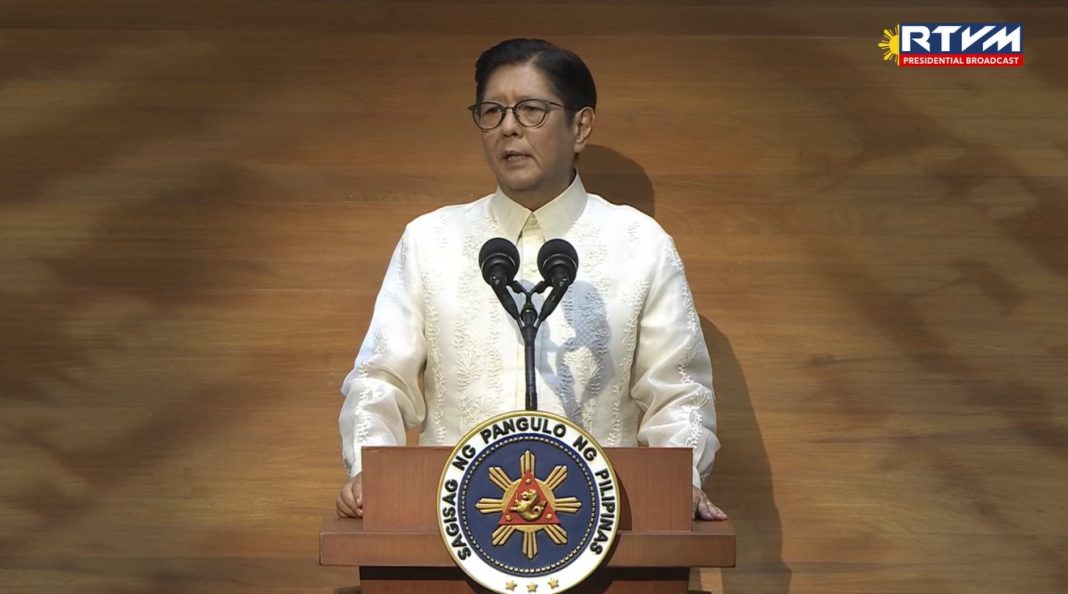
The national government has released over ₱3 billion in financial, food, medical, and shelter assistance to more than 600,000 families affected by recent earthquakes in the Visayas and Mindanao regions, President Ferdinand R. Marcos Jr. announced during his State of the Nation Address (SONA).
In his address, President Marcos emphasized the administration’s commitment to long-term recovery alongside immediate relief, noting that government agencies are actively rehabilitating critical infrastructure, including power lines, telecommunication networks, water supply systems, and key roads in the impacted areas.
“Hindi lang minsanang paghatid ng tulong ang ating ginagawa. Ang misyon natin ay sila’y muling makabangon at maitaguyod,” President Marcos stated, underscoring that disaster response must extend beyond initial aid to full rehabilitation.
Highlighting a strategic overhaul in national disaster management, the President detailed how the Philippines has transitioned from a reactive stance to a proactive, technology-driven approach. Powered by modern digital tools, the national framework now leverages public-private supply chains, hub-and-spoke warehousing models, automated production, and extensive pre-positioning of food and non-food items across local government units (LGUs).
To support this model, the administration has constructed a robust, nationwide disaster response network anchored by primary disaster resource centers in Luzon and the Visayas, with an additional center planned for Mindanao.
This infrastructure currently features:
-
15 central hubs
-
76 regional spokes
-
919 last-mile facilities strategically positioned across the country
With this network operational, emergency nourishment and critical relief supplies can now reach targeted disaster zones within 24 hours.
President Marcos also highlighted key technological upgrades designed to maintain power and connectivity during major emergencies:
-
Mobile Energy Systems: Pre-positioned mobile power units ready for rapid deployment to restore emergency electricity in blacked-out areas.
-
Resilient Communications: Integrated support through the Government Emergency Communications System alongside the country’s first private sector-led satellite-to-mobile service, ensuring uninterrupted telecommunications during national crises.
Furthermore, the administration has institutionalized the concept of a “State of Imminent Disaster.” This policy framework enables government agencies to trigger emergency protocols, allocate resources, and initiate preparations before a disaster strikes, ensuring maximum protection for vulnerable communities.

