


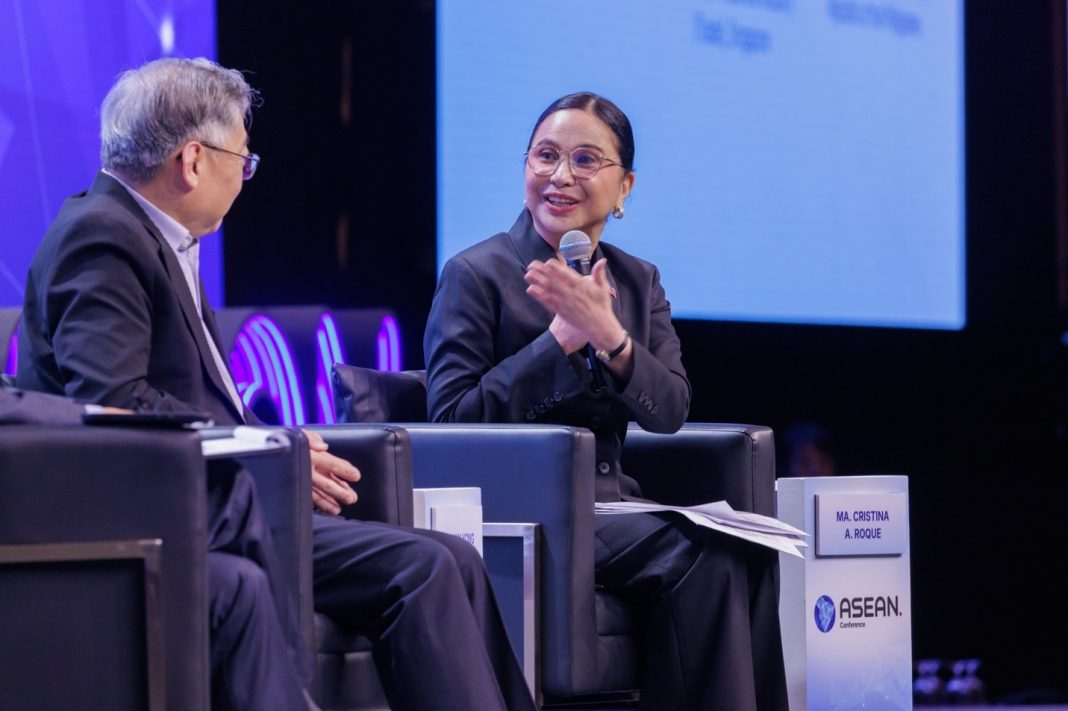
SINGAPORE—Department of Trade and Industry (DTI) Secretary Cristina A. Roque joined Singapore Deputy Prime Minister and Minister for Trade and Industry Gan Kim Yong at the Singapore Business Federation’s ASEAN Conference 2026 on July 31 to advance key ASEAN priorities. During the event, the Philippines championed the successful conclusion of the ASEAN Digital Economy Framework Agreement (DEFA) as a game-changer for regional integration and marking a major milestone toward the ASEAN Leaders’ vision of a digitally integrated, secure, interoperable, competitive, and inclusive regional economy.
Speaking at the Singapore Business Federation’s ASEAN Conference 2026 on July 31, Department of Trade and Industry (DTI) Secretary Cristina A. Roque advanced the Philippine ASEAN Chairmanship’s “Prosperity Corridors” pillar, which focuses on strategic trade, digital economy, critical minerals strategy, intellectual property, regional payment connectivity, and creative industries.
“As ASEAN’s first region-wide digital economy agreement, DEFA is designed to make digital trade easier, safer, and more seamless across our borders. With successful implementation, studies estimate that DEFA could help grow ASEAN’s digital economy to around USD 2-trillion by 2030,” Secretary Roque said.
“The Agreement provides a regional framework for ASEAN’s digital economy ecosystem, covering areas such as digital trade, cross-border e-commerce, digital payment, digital identifier, cyber security, data governance, competition policy, emerging technologies, and digital talent,” Roque added.
She joined Singapore Deputy Prime Minister and Minister for Trade and Industry Gan Kim Yong in a ministerial dialogue on ASEAN’s role amid geopolitical tensions, economic fragmentation and rapid technological change. The Philippines and Singapore hold ASEAN’s back-to-back chairmanships, in 2026 and 2027 respectively.
Amid global trade uncertainties, the Philippines is expanding access to new markets through regional and bilateral trade agreements. In July 2026, the country concluded negotiations for the Philippines–Chile Comprehensive Economic Partnership Agreement, its first free trade agreement in Latin America.
The agreement opens opportunities for Philippine exporters to access the Chilean market and use it as a gateway to Latin America. These market diversification efforts build on the country’s sustained export momentum. Philippine exports reached USD 29.93 billion from January to April 2026, up 11.1% from USD 26.93 billion during the same period in 2025. April exports alone grew by 6.3% to USD 7.21 billion, marking the country’s 16th consecutive month of export growth.
Secretary Roque cited the successful conclusion of ASEAN Digital Economy Framework Agreement (DEFA) negotiations in Manila in May 2026 and its scheduled signing at the 49th ASEAN Summit in November as a key achievement of the Philippine Chairmanship.
Once signed, DEFA will harmonize digital trade across ASEAN, reducing barriers to e-commerce. The Agreement also contains forward-looking and high-quality provisions that build on ASEAN’s ongoing digital integration efforts, including the ASEAN Single Window, digital payments connectivity, cross-border data initiatives, online consumer protection, and the ASEAN Unique Business Identification Number (UBIN).
MSMEs comprise 97% to 99% of all business establishments in ASEAN and account for around 85% of regional employment. However, varying rules on data, payments and electronic invoicing continue to raise the cost of cross-border transactions.
“With DEFA being the first region-wide digital economy agreement in the world, ASEAN as a bloc is now a very important force to reckon with, especially as ASEAN is widely projected to reach the milestone of becoming the world’s fourth-largest economy by 2030. Once we go as a bloc, this will really promote a lot of industries and elevate ASEAN as a major force in terms of trade and buying power that we can offer to the US market, to the EU market, and to the world,” the DTI chief added.
Beyond digital integration, the Philippines is promoting stronger regional support for creative industries to help ASEAN creators, artists, designers and cultural enterprises access wider markets while preserving the region’s distinct identities.
The Chairmanship likewise seeks to equip MSMEs and workers with the skills needed to use artificial intelligence and other emerging technologies productively and responsibly.
The Philippines is also advancing an ASEAN Economic Security Framework to identify economic vulnerabilities, strengthen supply chains and preserve the region’s openness, competitiveness and centrality.
The initiative complements efforts to conclude DEFA, advance regional payments connectivity, implement the upgraded ASEAN Trade in Goods Agreement, and modernize the ASEAN-China Free Trade Area.
Now in its 10th edition, SBF’s ASEAN Conference, themed “ASEAN’s Future in a Fractured World,” brought together senior government officials, policymakers, business leaders and SMEs from ASEAN and key partner economies.

