


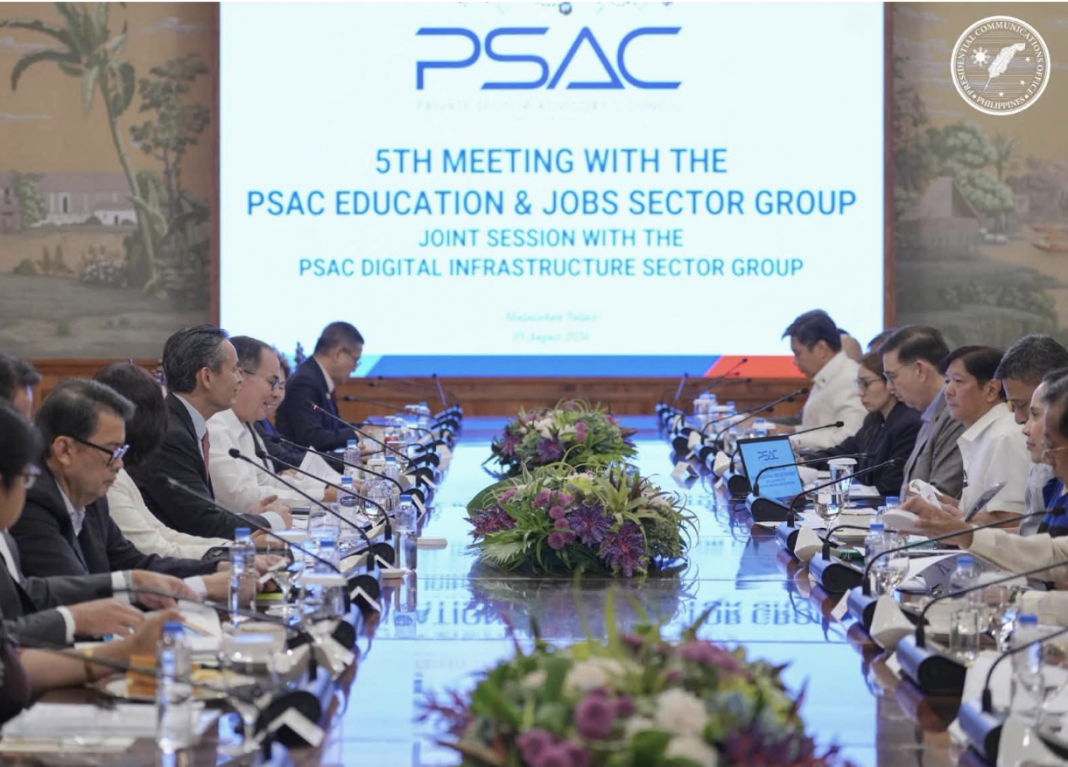
The Private Sector Advisory Council (PSAC) has recommended the creation of a National AI Implementation Taskforce to help the Philippines move faster in preparing workers, businesses, and government for the threats and opportunities brought about by artificial intelligence (AI).
The recommendation was presented during the 5th Meeting of the PSAC Education and Jobs Sector Group, held jointly with the PSAC Digital Infrastructure Sector Group at Malacañang Palace. The meeting focused on turning the country’s AI plans into concrete actions that will improve education and upskilling at scale, create better jobs and strengthen the country’s global competitiveness.
PSAC Strategic Convenor and Aboitiz Group President and CEO Sabin Aboitiz said the Philippines already has the National AI Strategy (NAIS PH). The next challenge is making sure it is carried out effectively through close collaboration between government and the private sector using a well-coordinated whole of nation approach.
“Artificial intelligence is no longer a technology of the future—it is already changing the way people work, learn, and do business today. Our priority is to make sure every Filipino has the opportunity to benefit from AI by creating better jobs, developing new skills, and strengthening industries that will drive long-term economic growth,” Aboitiz said.
Turning plans into action
PSAC noted that while several national AI strategies have already been developed, implementation remains fragmented because responsibilities are spread across different agencies without a single coordinating body. The proposed National AI Implementation Taskforce aims to bring government agencies, industry groups, academe, and other stakeholders together under one implementation framework.
The proposed taskforce will focus on three major areas:
- Education and workforce development to equip Filipinos with AI and digital skills;
- Technology, infrastructure, and R&D to support innovation and AI adoption; and
- Policy, governance, and demand generation to create new economic opportunities, generate high-quality jobs, and promote the responsible adoption of AI.
PSAC emphasized that this whole-of-nation approach will help ensure that AI benefits not only large companies but also students, workers, entrepreneurs, and small businesses.
AI should create opportunities for every Filipino
The Council’s vision is simple: AI should be for everyone, not just a few. It envisions a future where more Filipinos use AI to improve their work, increase productivity, build new businesses, and compete globally. This includes supporting AI-enabled services exports, creative industries, digital solopreneurs, advanced manufacturing, and public services while generating quality jobs and higher incomes.
To help augment the country’s AI talent pipeline, PSAC also recommended the release of ₱650 million from the Higher Education Development Fund (HEDF) to the Commission on Higher Education (CHED). The funding will support priority AI upskilling programs in 2026 across colleges and universities, helping students gain the skills needed for emerging industries.
Building on ongoing programs
The Council also reviewed progress on several initiatives already underway to improve jobs and skills nationwide.
Since November 2023, nearly 500 job fairs have been conducted across 15 regions, serving more than 322,000 job seekers through partnerships among government, local governments, and the private sector. At the same time, digital training has expanded beyond basic digital literacy to include AI, cybersecurity, robotics, and information security. Financial literacy programs have also reached more than 25 million Filipinos, helping people build stronger financial and digital capabilities.
PSAC likewise highlighted continued support for micro, small, and medium enterprises (MSMEs) through the Trabaho at Negosyo initiative, which combines entrepreneurship mentoring with job matching to help both businesses and job seekers. Since March 2026, the program has served more than 4,000 participants across several regions while connecting them with government agencies, private companies, and industry mentors.
Strengthening key industries
Beyond AI, PSAC reaffirmed its support for the implementation of the country’s semiconductor and electronics roadmap, recognizing the industry’s potential to create high-value jobs and attract investments. The Council also recommended strengthening public-private coordination to position the Philippines as a trusted player in the global technology supply chain.
PSAC also welcomed the strengthened partnership between the Education and Workforce Development Group (EWDG, the cabinet cluster for education) and the Industry, Academe and Civil Society Council for Education (IACCE). The collaboration aims to help the government in implementing the 10 year National Education and Workforce Development Plan (NatPlan). It is focused on solving the crucial problem of job-skills mismatch, through initiatives such as the rapid acceleration of curriculum development—particularly for fast-growing sectors such as AI and semiconductors—so that graduates gain skills that match industry’s rapidly evolving needs.
A shared responsibility
PSAC stressed that preparing the Philippines for the AI era requires sustained collaboration between government, business, academe, and civil society.
The Council believes that with stronger coordination, faster implementation, and continued investment in people, the country can create more quality jobs, help businesses become more competitive, and ensure that the benefits of AI are shared by all Filipinos.
The recommendations presented during the meeting include creating the National AI Implementation Taskforce through an Administrative Order, funding AI upskilling in higher education, accelerating the semiconductor roadmap, and institutionalizing long-term public-private collaboration in education and workforce development.

