


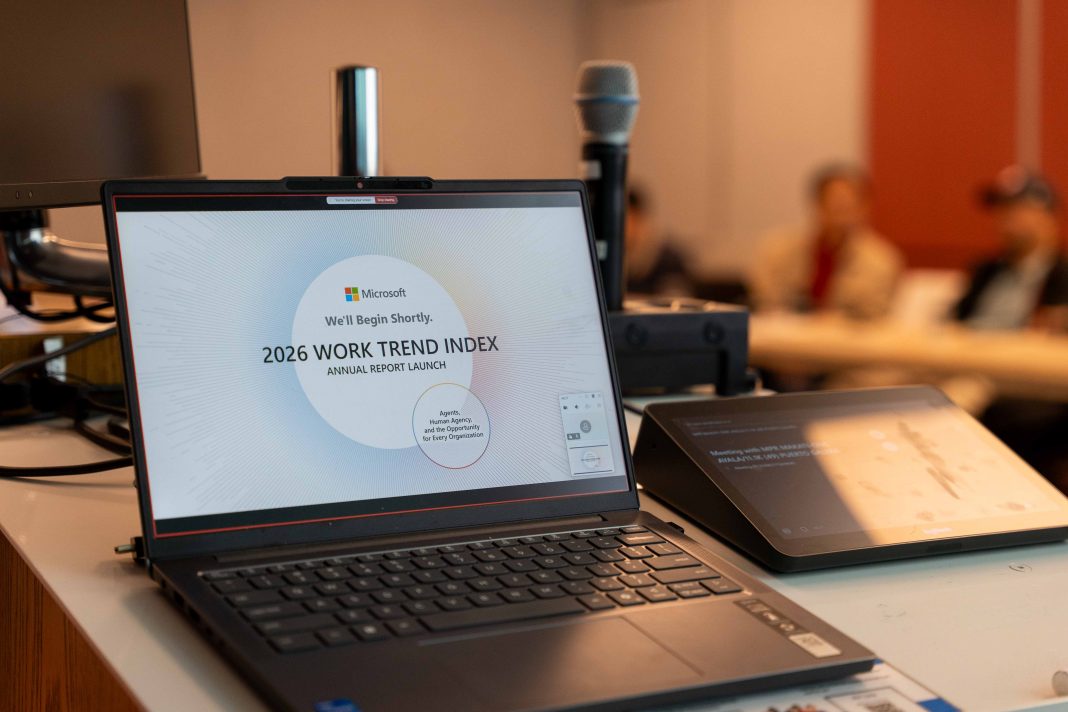
Filipino professionals are emerging as some of the world’s most advanced AI users, according to the 2026 Microsoft Work Trend Index Annual Report released today.
Titled Agents, Human Agency, and the Opportunity for Every Organization, the report is based on a survey of 20,000 workers using AI across 10 markets globally, with the research later extended to 11 additional markets, as well as trillions of anonymized Microsoft 365 productivity signals.
It shows the Philippines pulling ahead of the global curve in using AI to expand what people can achieve at work.
Microsoft shared the findings at a media briefing in Manila, where PLDT and Smart—which recently deployed 1,000 Microsoft 365 Copilot seats—joined a moderated conversation on what frontier transformation looks like in practice.
The report’s headline finding is that 25% of Filipino workers now qualify as “Frontier Professionals,” the most advanced category of AI users. These professionals routinely use AI agents for multi-step workflows, rethink business processes, and help establish new quality standards for AI-assisted work. This is well above the global average of 16%, placing the Philippines among the leading markets surveyed.
Filipinos are producing work they couldn’t do a year ago
Among Filipino AI users, 77% say they are producing work they could not have produced a year ago, compared with 58% globally. Among the country’s Frontier Professionals, that figure rises to 86%.
As the report puts it: “AI is not just helping us do things faster. It’s expanding who can do high-value work.”

Philippines leads the world on critical thinking and human judgment
As AI takes on more execution, Filipino workers are placing even greater emphasis on uniquely human capabilities. The findings stand out globally:
- 65% of Filipino AI users say critical thinking is the most important human skill as AI takes on more work—the highest of any market surveyed and well above the global average of 46%.
- 59% identify quality control of AI output as the top priority, compared with 50% globally.
- 93% say they treat AI output as a starting point rather than a final answer and that they “stay responsible for the thinking,” among the highest rates globally (86%).
Filipino Frontier Professionals are also more deliberate about protecting their expertise. More than half (53%) intentionally complete some work without AI to keep their skills sharp, compared with 42% of their non-Frontier peers. In addition, 61% intentionally pause before starting work to determine what should be handled by AI and what should remain human-led, compared with 47% of non-Frontier professionals.
“The Philippines is showing what the next chapter of AI adoption can look like when people combine ambition with judgment, accountability, and practical execution. Filipino professionals are not only using AI to work faster; they are using it to expand what they can deliver, while staying clear that human judgment, critical thinking, and quality control remain essential.
For organizations, the opportunity now is to move from experimentation to execution—building the right foundations of trusted platforms, strong governance, responsible AI practices, and the skills that help people bring AI into everyday workflows with confidence, ” said Mayank Wadhwa, President, Microsoft ASEAN.
The Transformation Paradox: workers are ready—but the system has to catch up
The report’s central insight, which Microsoft calls the Transformation Paradox, is that employees are adopting AI faster than the organizations around them. In the Philippines, the outlook is more encouraging than in many other markets, but important gaps remain:
- 35% of Filipino AI users say their leadership is clearly and consistently aligned on AI, compared with the global average of 26%—even so, that represents only about one in three workers.
- 66% worry they will fall behind if they do not adapt quickly to AI, while 53% say it feels safer to focus on current priorities than to redesign work with AI.
- 25% say they are rewarded for reinventing how they work, nearly double the global average of 13%—yet organizational incentives have yet to fully keep pace with new ways of working.
Managers and team culture make the difference
Filipino Frontier Professionals consistently report stronger workplace support than their non-Frontier peers. Compared with other workers, they are more likely to say their managers:
- Openly use AI (86% vs. 78%)
- Set quality standards for AI-assisted work (86% vs. 75%)
- Create space for experimentation (86% vs. 71%)
- Encourage more ambitious approaches to redesigning work (87% vs. 76%)
Their teams also demonstrate more collaborative AI practices. Nearly three-quarters (74%) regularly brainstorm and refine business processes together to identify AI opportunities, compared with 55% of non-Frontier teams. In addition, 61% actively share AI tips, new agents, and lessons learned (vs. 45%), while 56% discuss quality standards for AI-assisted work (vs. 43%).
Microsoft’s analysis underscores why this matters: organizational factors—culture, manager support, and talent practices—account for more than twice the impact of individual mindset and behavior alone (67% vs. 32%).
Frontier transformation in practice: PLDT and Smart
For a growing number of Philippine organizations, that shift from individual AI use to organizational capability is already underway. PLDT and Smart recently rolled out 1,000 Microsoft 365 Copilot seats as part of a broader effort to embed AI into everyday workflows across the business—a concrete example of the frontier transformation the report describes, where AI moves from isolated pilots into the daily rhythm of how teams work.
Speaking at the launch briefing in Manila, Gilbert Gaw, First Vice President and Head of Information Technology and the Transformation Office at PLDT and Smart, shared how the company is approaching that shift:
“At PLDT and Smart, AI is not just a technology rollout. The real opportunity is to rethink how work gets done, so our teams can simplify processes, respond faster, and create more meaningful value for customers.
Frontier transformation happens when AI moves from pilots into everyday workflows, supported by the right training, governance, and people adoption. That is how AI becomes real business impact, ” said Gilbert Gaw, First Vice President and Head of Information Technology and the Transformation Office, PLDT and Smart.
The road ahead: Every organization is becoming a Learning System
The report calls on leaders to do more than adopt AI tools; it encourages organizations to rearchitect work. As the report states, “The real question isn’t whether people have the right skills. It’s whether the organization is built to unlock them.”
The findings also highlight the accelerating pace of AI adoption. AI agents have grown 15 times year over year across the Microsoft 365 ecosystem and 18 times in large enterprises. Organizations that can capture, share, and scale what their people learn from working with AI—what the report describes as becoming a Learning System—will be best positioned to create long-term value.
For the Philippines, the findings underscore a significant opportunity. Filipino professionals have demonstrated a high level of AI readiness and strong human judgment. The next phase will depend on how organizations translate that momentum into consistent, trusted, and scalable ways of working—exactly the kind of shift now underway at enterprises like PLDT and Smart.
“When trusted technology, skilled people, and clear leadership come together, AI can move beyond individual productivity and become a driver of durable business value. Across ASEAN, that is the opportunity ahead: to translate AI ambition into execution in ways that strengthen competitiveness, build trust, and create more inclusive growth for people, organizations, and economies, ” said Mayank Wadhwa, President, Microsoft ASEAN.

