


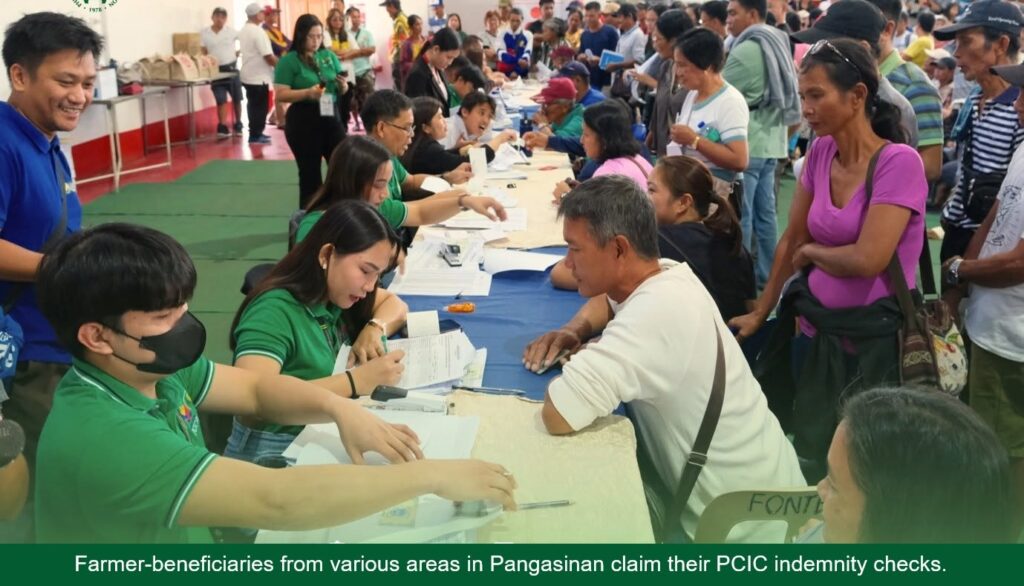
The Philippine Crop Insurance Corp. is preparing P36 million in insurance payouts for 5,005 farmers whose insured farms were damaged by Typhoons Luis and Maymay, and the southwest monsoon from Aug. 1 to 11.
In his initial report to Agriculture Secretary Francisco P. Tiu Laurel Jr., PCIC President Jovy Bernabe said the state crop insurer had mobilized its regional offices to validate losses and speed up claims processing.
Initial estimates put insured damage at P35.67 million across six regions. Region III had the most affected farmers, with 1,836, followed by Region I with 1,218, and Region IV-B with 836.
Region I recorded the largest estimated insured damage at P9.89 million, followed by Region III at P8.80 million and Region IV-B at P7.56 million. Region IV-A recorded P5.04 million in estimated damage, while Region II and Region VI reported P3.47 million and P0.92 million, respectively.
Rice accounted for the largest share of insured losses at P25.60 million, while corn damage was estimated at P3.55 million and high-value crops at P3.73 million.
Tiu Laurel said government assistance must reach farmers and fisherfolk quickly after disasters to prevent temporary losses from becoming long-term livelihood setbacks.
“We need to respond immediately to the needs of our farmers and fisherfolk after every calamity so they can recover quickly and sustain their livelihoods,” Tiu Laurel said.
The agriculture chief said timely assistance is particularly important for farmers who depend on each production cycle to generate income and finance the next crop.
Bernabe said PCIC is strengthening its response to get affected farmers back on their feet as quickly as possible. He said the agency is also leveraging new technologies to accelerate damage assessment.
“We are stepping up our efforts to assess damage, process claims, and deliver insurance assistance faster so our farmers can get back on their feet and return to production,” Bernabe said.
PCIC has instructed its regional offices to continue assisting affected farmers and expedite the processing of legitimate claims.
The initial assessment may still change as field validation continues, but the figures already highlight the financial role of crop insurance when extreme weather disrupts farm operations.
For farmers, timing matters. A payout that arrives quickly can help finance replanting, replace damaged inputs, settle immediate expenses, and keep one disastrous harvest from disrupting the next production cycle.
The PCIC response is therefore not simply about paying claims. It provides a financial bridge between disaster and recovery, helping farmers restore production before lost income becomes a deeper livelihood problem.
Bernabe said farmers and fisherfolk registered with the Registry System for Basic Sectors in Agriculture (RSBSA) may avail themselves of premium-free crop insurance from the PCIC, provided they enroll with the insurer every planting season or when raising new livestock. He added that farm equipment and other agricultural assets may also be covered by insurance.
As weather disruptions continue to test Philippine agriculture, faster insurance payouts are becoming an increasingly important part of the country’s disaster response and food security strategy.

