


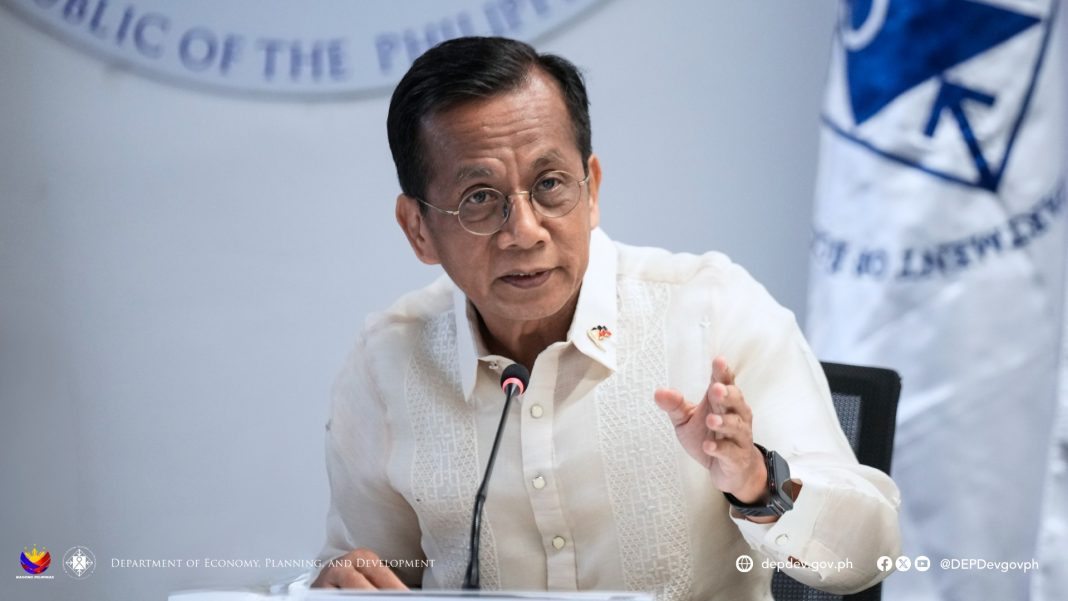
Having attained upper-middle-income status, the Philippines must diversify its growth drivers beyond consumption and services to sustain growth and advance toward high-income status, Department of Economy, Planning, and Development (DEPDev) Secretary Arsenio M. Balisacan emphasized in his presentation, “Building on Upper-Middle-Income Status: Economic Performance, Outlook and Policy Priorities,” during the Economic Journalists Association of the Philippines (EJAP) Economic Forum on August 14.
Balisacan said the country’s recent reclassification reflects three decades of sound macroeconomic management and structural reforms that have strengthened the economy’s capacity to withstand shocks and sustain its long-term growth.
“The Philippines’ economic progress in the past two decades has been anchored in sound macroeconomic management and hard-won structural reforms. Despite successive global and domestic shocks, the economy has rebounded and remained resilient.”
While household consumption and services have been important drivers of growth in recent years, Balisacan said the country now needs a more diversified growth strategy to sustain momentum and accelerate its progress.
“For too long, consumption and services have served as our primary economic engines. Moving forward, our focus must expand to generating robust investment, strengthening high-value exports, and revitalizing agriculture and industry.”
To support this broader growth strategy, the DEPDev chief underscored the need to raise productivity through innovation, technology adoption, capital deepening, and investments in human capital.
He added that preparing Filipino workers for artificial intelligence and other emerging technologies through education, upskilling, and reskilling will be critical to raising productivity and competitiveness while ensuring the creation of quality, future-ready jobs.
Balisacan likewise stressed that the benefits of higher productivity and sustained economic growth must be broadly shared. This will require continued investments in health, education, food security, and social protection, particularly to strengthen the resilience of vulnerable households and ensure that they are able to participate in and benefit from economic opportunities.
These priorities, he said, are central to the government’s commitment to achieving faster, productivity-driven, and inclusive growth as the country builds on its upper-middle-income status.
“Our mission remains the same: economic growth that is diversified, productivity-driven, and inclusive. Staying this course will demand trust and confidence-building governance; bold structural reforms; sustained and strategic investments; and an unwavering commitment to our ultimate goal—a matatag, maginhawa, at panatag na buhay for all Filipinos.”

