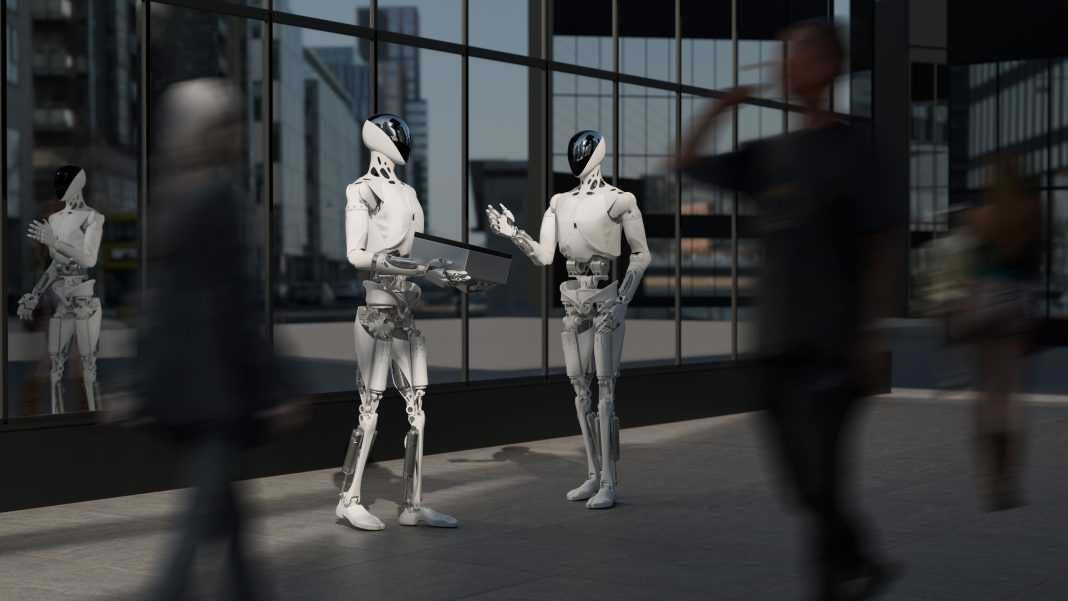
Global artificial intelligence (AI) mobility company XPENG has raised more than USD900 million for its robotics business in a funding round ahead of the launch of its AI mobility solutions in the Philippines in September.
In a statement, XPENG said the funding round was led by IDG Capital, with participation from Gaorong Ventures and support from Tencent and Alibaba as strategic investors. The transaction values the robotics business at more than USD6.3 billion, making it the largest single-round private capital raise to date in China’s embodied AI industry and reinforcing XPENG’s growing investment in AI and its real-world applications.
XPENG will retain controlling ownership of its robotics business following the completion of the financing round. The business will also continue to be consolidated into the Group’s financial statements.
The latest investment will support further hardware and software research and development for XPENG’s robotics business, continued training and improvement of its Physical AI models, real-world data generation, development of mass-production facilities, and future commercial expansion in China and overseas markets.
He Xiaopeng, chairman and CEO of XPENG, said that for the past 12 years XPENG has remained committed to full-stack in-house R&D, building a solid technological foundation for the Physical AI era across its physical world foundation model, Turing AI chips, and AI infrastructure. This has enabled us to pioneer a new phase of mass production and commercial deployment for advanced humanoid robots.
“I believe the strong capital backing from leading global and strategic investors provides the resources needed to accelerate the growth of our robotics business, while strengthening our ability to attract more world-class Physical AI talent. IRON brings together a highly human-like design, advanced AI intelligence, built to the highest standards of safety and quality. Our ambition is for IRON to become a trusted partner for people and a meaningful part of everyday work and life.”
At the center of XPENG’s robotics program is IRON, a next-generation humanoid robot designed to perform a range of tasks in environments built for people. It has 76 degrees of freedom across its body and 21 in each hand, enabling human-like movement and dexterity.
IRON is powered by three XPENG Turing AI chips that deliver up to 2,250 trillion operations per second of onboard computing power. This allows the robot to process information and perform complex tasks with less reliance on remote operation.
IRON is expected to enter mass production by the end of 2026, with initial deployment at XPENG stores and campuses. Its official launch and deliveries in China and overseas markets are planned for 2027.
For the Philippine market, XPENG will launch two electric vehicle models: the flagship XPENG X9 intelligent seven-seater and the stylish XPENG L03 SUV coupe.
As XPENG enters the Philippine market, the X9 and L03 will serve as the first local expressions of its broader technology ecosystem. Their introduction will allow Filipino motorists to experience how XPENG is applying AI not only as an in-vehicle feature but also as a core technology designed to help machines understand, adapt to, and respond to people and the world around them.
XPENG’s approach extends beyond developing electric vehicles. The company is building AI technologies that can be applied across intelligent vehicles, humanoid robots, aerial mobility, and smart manufacturing. These technologies include proprietary AI chips, intelligent driving systems, computing infrastructure, and Physical AI models.
Physical AI refers to artificial intelligence that enables machines, including vehicles and robots, to perceive their surroundings, make decisions, and respond to real-world conditions.
For Filipino motorists, this approach will initially be experienced through the X9 and L03, where AI is designed to help the vehicles understand their environment, respond to different driving situations, and interact more intuitively with their users.