


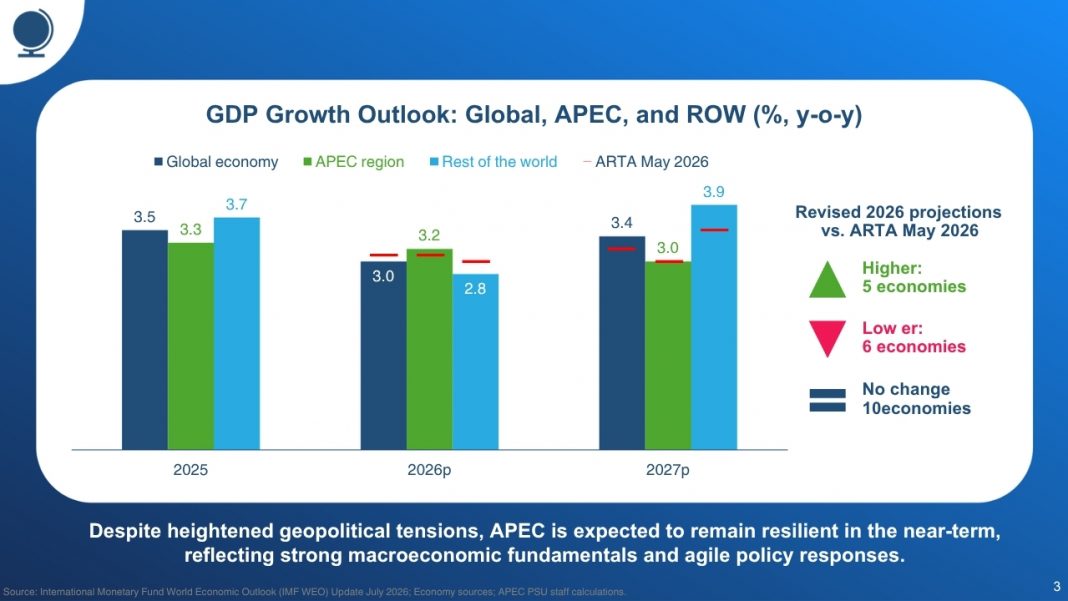
Freight costs across the Asia-Pacific Economic Cooperation (APEC) region have climbed steadily since mid-2025, with tight vessel capacity and rising fuel and insurance costs pushing shipping rates higher on both intra-Asia and long-haul trade lanes even as merchandise trade posted its strongest growth in two years, according to the APEC Regional Trends Analysis (ARTA) (https://www.apec.org/publications/2026/08/apec-regional-trends-analysis-august-2026) released this month by the APEC Policy Support Unit (PSU).
The August 2026 report (https://www.apec.org/publications/2026/08/apec-regional-trends-analysis-august-2026), prepared by PSU analyst Rhea Crisologo Hernando and researcher Eldo Malba Simanjuntak, found that freight indices for extra-Asia routes such as Shanghai to Los Angeles have more than doubled since July 2025, while Shanghai to New York, Genoa and Rotterdam have each risen by roughly a third to a half over the same period. Intra-Asia routes showed a more uneven pattern: costs on the Ho Chi Minh City-to-Shanghai and Shanghai-to-Tj. Pelepas lanes surged, while Busan-to-Shanghai and Yokohama-to-Shanghai rates fell well below their July 2025 baseline.
“Freight costs remain on an upward trend as tight capacity, along with higher fuel and insurance costs, keep pressure on both intra-Asia and extra-Asia routes,” the report said, citing data from Drewry Supply Chain Advisors.
Growth seen moderating to 3.2% as trade offsets mounting risks
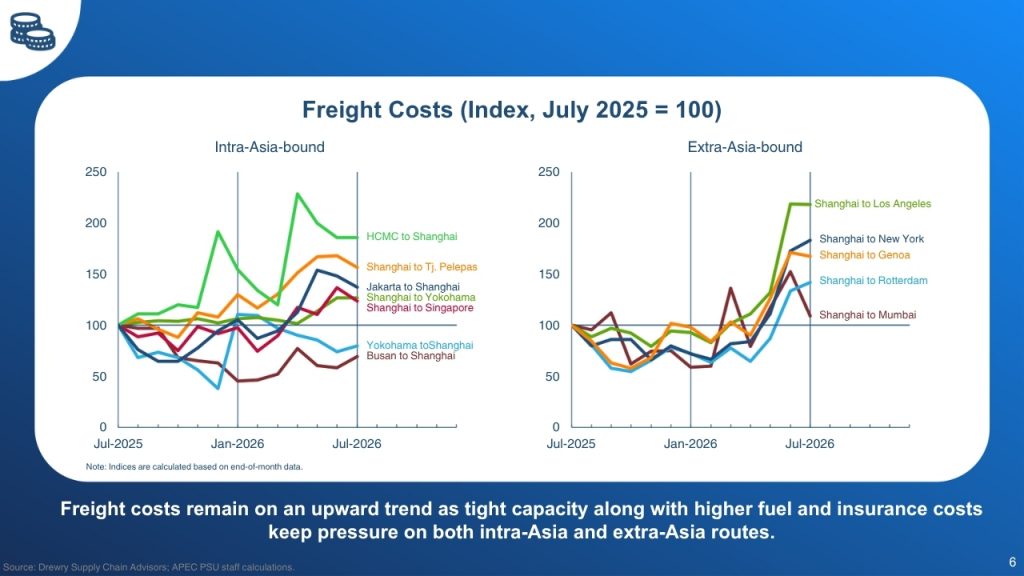
The PSU stated in a press release at the APEC meet in Dalian, China, that the APEC region will grow by 3.2 percent in 2026. Strong trade and investment in technology will drive this growth, despite challenges such as rising energy costs, geopolitical tensions, and uncertainty in trade policies. The growth rate is anticipated to decrease from 3.3 percent in 2025 to 3.2 percent in 2026 and further to 3.0 percent in 2027.
Although the growth forecasts have been revised upward for five APEC economies and downward for six, the overall regional forecast for 2026 remains unchanged, with projections for ten economies being maintained
“APEC continues to grow despite a much more challenging external environment, with technology investments, trade, and digital services playing a crucial role in supporting the regional economy,” stated Carlos Kuriyama, director of the APEC Policy Support Unit.
“However, the sources of growth are becoming increasingly concentrated, and risks are emerging from multiple directions. Higher energy costs, uncertainty in geopolitical and trade policies, and weather-related disruptions could all undermine consumption and investment. Economies need to strengthen alternative sources of growth while effectively leveraging the current momentum driven by technology,” he added.
Merchandise exports and imports grew significantly in the first quarter, rising 18.8 percent and 10.2 percent in value, respectively, compared to the same period last year. This contrasts with a growth rate of 5.1 percent for exports and 7.9 percent for imports in the first quarter of 2025, according to World Trade Organization data cited in the report. In terms of volume, exports and imports increased by 10.8 percent and 11.1 percent, respectively, driven by strong demand for technology products across the region.
However, the trade in commercial services presented a different picture. Total commercial services exports grew by 5.4 percent year-on-year in the first quarter of 2026, down from 7.5 percent in the same period of 2025 and 11.3 percent in 2024. This slowdown was attributed to more moderate increases in travel, transport, and goods-related services. Notably, transport services exports fell into negative territory, contracting by 3.9 percent year-on-year, in contrast to a 9.1-percent growth a year earlier.
Travel services exports grew by only 10.6 percent, which is significantly lower than the 30.9-percent growth recorded in 2024, as the post-pandemic boost in tourism continues to diminish.
Additionally, the trade data highlights increasing structural imbalances. Since 2020, APEC’s overall merchandise goods surplus and commercial services deficit have widened. In 2025, the region’s net trade balance turned positive again after several years of near-zero levels, as reported by the PSU. This shift reflects ongoing disparities between economies with strong export bases and those that rely heavily on imports.
Rising freight and food costs are contributing to the region’s inflation outlook. Inflation across APEC is expected to rise to 2.9 percent in 2026, up from 2.4 percent last year, before easing to 2.5 percent in 2027. This increase is primarily driven by higher food and transportation costs, which are putting renewed pressure on prices. Additionally, increased fuel and insurance costs, along with limited shipping capacity, have resulted in higher freight rates on several intra-Asia and long-haul routes.
“Central banks are facing renewed price pressures at a time when economic growth is anticipated to slow down,” said Hernando, an analyst with the APEC Policy Support Unit. “The challenge is to keep inflation expectations stable without unnecessarily hindering economic activity, particularly when these price pressures are stemming from external supply shocks. The persistence and magnitude of these pressures will be crucial in determining the appropriate monetary policy response,” she added.
Investment, meanwhile, is increasingly flowing into technology and energy. Information and communications, electronics, and energy accounted for 57.6 percent of global greenfield investment in 2025, nearly 10 percentage points more than five years earlier, while foreign direct investment in APEC remained broadly stable.
Weather as a growing economic risk
The analysis highlights weather as an increasing economic risk. An intensifying El Niño could lead to drought, heat stress, and flooding in various parts of the region, which may reduce agricultural output and contribute to rising food prices. Currently, supplies of key agricultural products are adequate; however, the balance for milled rice, oilseeds, and vegetable oils is tightening.
“The economic risks we are monitoring are becoming more interconnected,” said Simanjuntak, a researcher with the APEC Policy Support Unit. “A weather shock can impact agricultural production and food prices, while rising energy and shipping costs can be passed on to businesses and consumers. Strengthening supply chains, food security, and productive investment will be crucial to prevent these shocks from hindering overall economic growth.”
The PSU’s policy recommendations emphasize the need for investment in digital infrastructure and connectivity, enhancing supply chains, building more resilient agricultural systems, establishing early warning systems, and improving the investment environment to support long-term growth.
APEC’s 21 member economies collectively represent a significant share of global trade, and the ARTA report is periodically published to track macroeconomic, trade, and investment trends across the region.

