


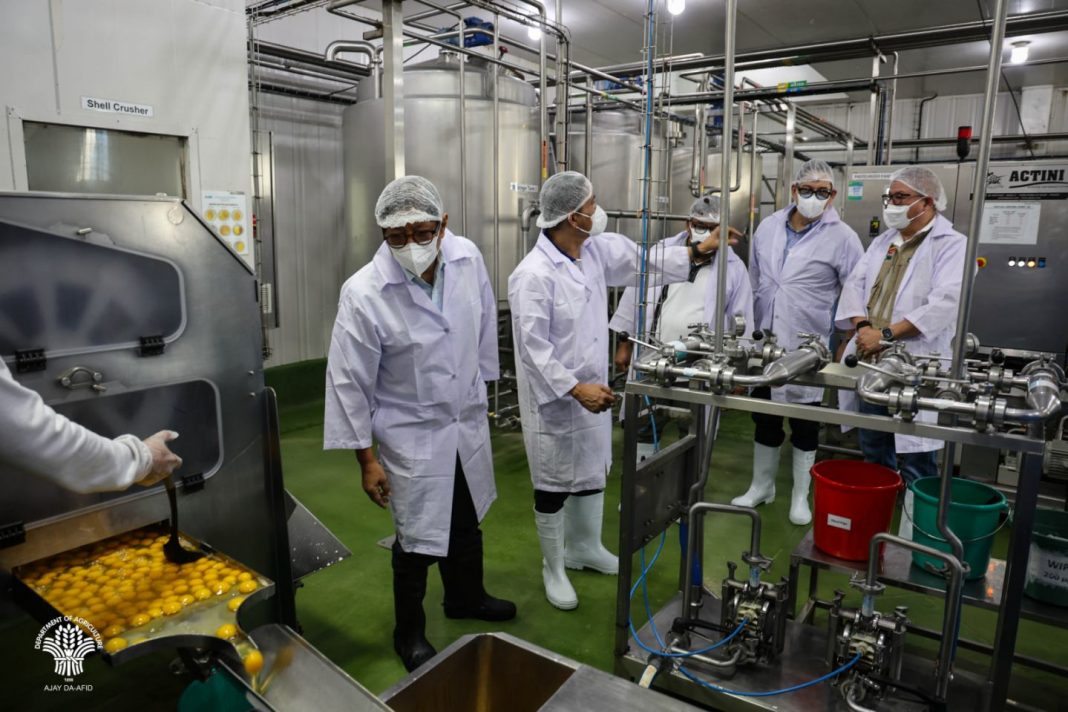
SAN JOSE, Batangas —President Ferdinand Marcos Jr., accompanied by Agriculture Secretary Francisco P. Tiu Laurel Jr., on Thursday visited the P300-million egg processing facility of Batangas Egg Producers Multipurpose Cooperative (BEPCO) located in Barangay Don Luis in this Batangas town, acknowledged as the country’s egg capital.
The facility was designed to add value to the 7 million-10 million eggs produced per day—depending on the season—by the municipality of San Jose while BEPCO is the key partner of DA in Egg Industry Development Project (EIDP).
Under the Republic Act No. 11707, signed in April 2022, San Jose was officially declared as the “Egg Basket of the Philippines.”
From the technology developed by the Department of Science and Technology (DOST) and funded by the Department of Agriculture, the project aims to produce liquid and pasteurized eggs using Good Manufacturing Practices that ensure food safety, and longer shelf life.
Stressing the government’s food security agenda, Secretary Tiu Laurel said the importance of helping egg farmers to preserve their production, manage supply more efficiently, and making eggs a high valued product. “Food security is not only about producing enough. It is also about assuring our farmers and egg producers to have stable livelihoods and incomes, while consumers have a steady and reasonable price supply.”
He also said that efficient processing and improve storage capacity can help reduce losses, cushion producers and consumers from supply fluctuations, and keep egg products more consistently available in the market.
At the heart of the facility is an upgraded pasteurization line capable of processing 1,400 kilos. of liquid egg, equivalent to 28,000 50-gram eggs, per hour Eggs are washed, broken, separated or combined as whole eggs, mixed, and pasteurized under controlled conditions before being packaged. Finished products undergo strict quality control, microbiological testing including Salmonella checks, and labeling before dispatch.
This upgrade is supported by a P50-million grant under EIDP. To complete eggs shelf life extension, the DA provided a three-story cold storage facility funded through a P50-million grant, with capacity for up to 80 tons of finished products. Walk-in chillers maintain temperatures of 0 to 4 degrees Celsius, while freezers operate at minus 18 degrees Celsius. An upgraded blast freezer can freeze liquid egg batches in as little as three hours, compared with the standard eight hours, speeding up storage while preserving product quality.
The facility also features a spray drying operation supported by a DA grant and more than P16 million in DOST equipment loan assistance. It converts liquid egg into powdered white, yolk, and whole egg, extending shelf life to as much as two years and opening new opportunities for storage, distribution, and markets. For the government, the project is more than a storage facility. It is an investment in the egg industry’s capacity to protect producer incomes, reduce waste, stabilize supply, and ultimately help keep prices more manageable for consumers.
The project also reflects the administration’s broader push to modernize agriculture by linking public investment with science, technology, and private-sector partnership to build a more efficient and resilient food supply chain.

