


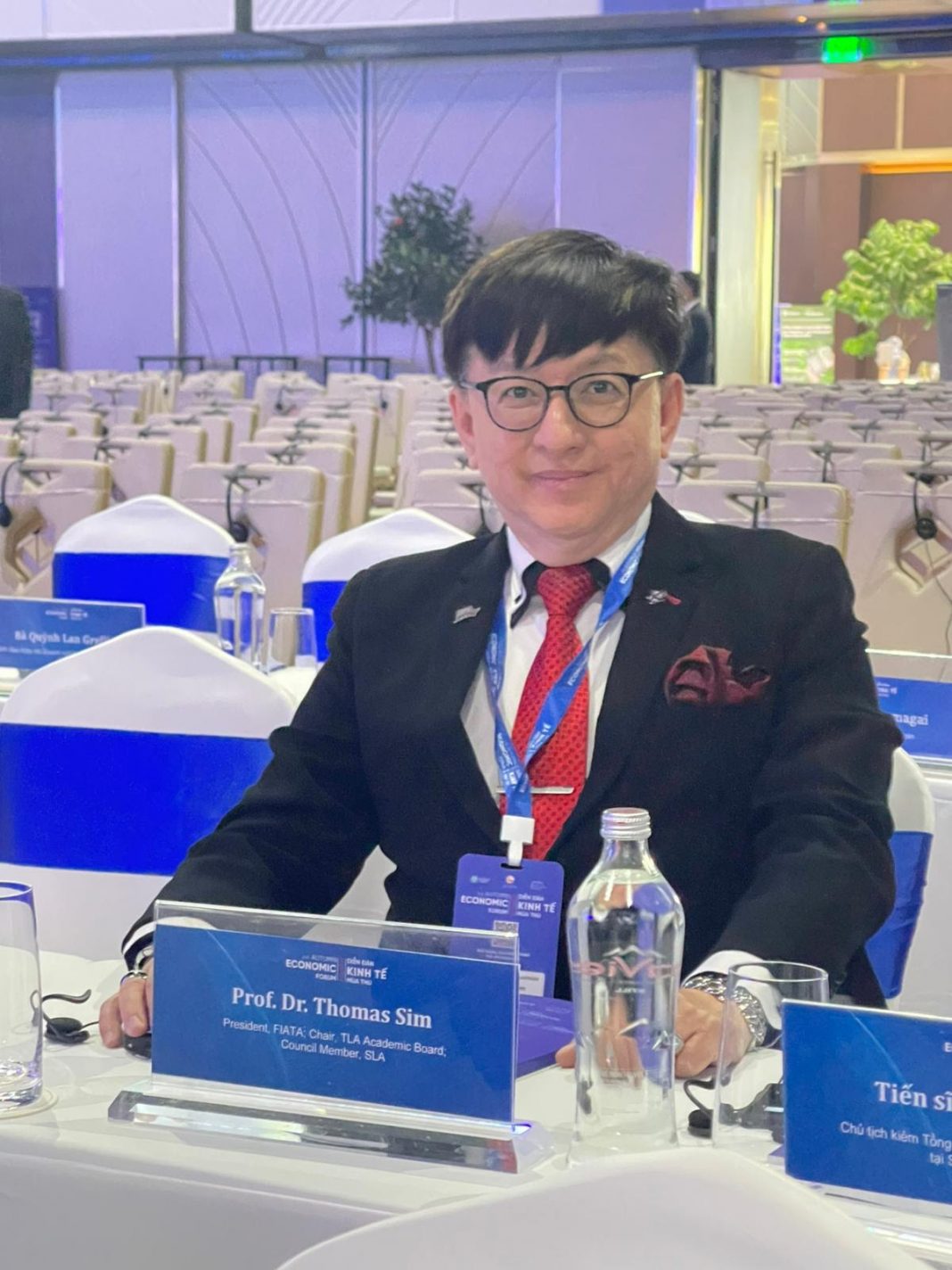
The International Federation of Freight Forwarders Associations (FIATA) has concluded a week of high-level international engagement, with its leadership strengthening dialogue on digitalization, sustainability, and human capital across key global platforms in Asia and the Middle East.
FIATA’s representatives emphasized that future-proof logistics require deep public–private collaboration, investment in digital infrastructure, and a focus on next-generation skills.
FIATA President, Prof. Dr Thomas Sim, addressed the prestigious Autumn Economic Forum in Ho Chi Minh City, Vietnam (25–27 November), focusing on the drivers of national economic competitiveness in a period of significant global change.
Prof. Dr Sim highlighted that the most competitive economies are those that seamlessly integrate digitalization, environmental ambition, and smart port ecosystems into coherent national strategies.
“Smart logistics thrives when policy alignment, supportive infrastructure, and industry-led innovation come together,” stated Prof. Dr Sim. “Public–private partnerships are central to this progress, with authorities creating the enabling environment while the industry advances new solutions.”
He showcased FIATA’s efforts to advance digital trade, including its work on the digital, negotiable FIATA Multimodal Transport Bill of Lading (eFBL). Crucially, Prof. Dr Sim stressed that the future of logistics relies equally on human capital. He called for skills and training to empower the next generation of logisticians to be digitally fluent, sustainability-focused, and equipped to drive meaningful innovation.
Meanwhile, FIATA Senior Vice-President, Ms Nadia Abdul Aziz, represented FIATA at the Logistics Leaders MENA Conference in Dubai, UAE, highlighting FIATA’s global leadership in capacity building, facilitation, and innovation.
Ms Abdul Aziz acknowledged the UAE’s strategic location, strong infrastructure, and rapid digital adoption, while addressing the contemporary challenges facing logistics, including geopolitical tensions, regulatory changes, supply chain volatility, and financial pressures. The discussion underscored the critical need for resilient, technology-enabled networks supported by long-term infrastructure projects, such as the development of Etihad Rail.
She further underlined the importance of upskilling and cross-training in advanced fields:
Artificial Intelligence
Digital Twins
Blockchain Documentation
Advanced Forecasting
These capabilities, Ms Abdul Aziz noted, are essential for enhancing crisis and risk management, safety, compliance, and quality control. She highlighted the joint efforts between FIATA and the National Association of Freight and Logistics (NAFL) on digitalization, training, regulatory alignment, and industry cooperation to sustain the UAE’s role as a leading global logistics and transshipment hub.

