


Global economic growth is forecast to slow to 2.6 per cent in 2025, down from 2.9 per cent in 2024, as financial volatility and geopolitical uncertainty increasingly constrain global trade and investment, according to the new UN Trade and Development (UNCTAD) report, ‘Trade and Development Report 2025: On the Brink – Trade, finance and the reshaping of the global economy’.
The report finds that global trade is now almost as strongly influenced by shifts in financial markets—such as interest rate changes and capital flows—as by real economic activity, a trend that significantly impacts development prospects worldwide.
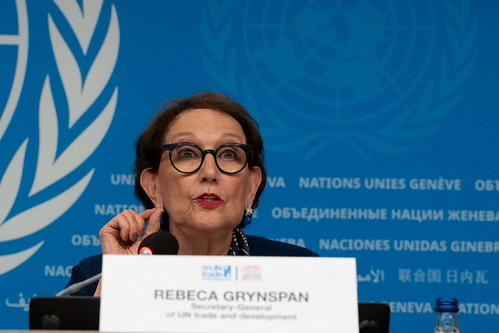
UNCTAD Secretary-General Rebeca Grynspan underscored the pivotal role of finance in global commerce. “Trade is not just a chain of suppliers. It is also a chain of credit lines, payment systems, currency markets, and capital flows,” she stated.
With nearly 90 per cent of world trade dependent on trade finance, and international transactions relying heavily on dollar liquidity and cross-border payment systems, changes in major financial centers—like a shift in interest rates—can directly affect trade volumes globally. Underlying trade growth is estimated at 2.5 to 3 per cent and is expected to ease further as financial conditions exert a stronger influence on production and investment.
The report also notes that for several major food trading companies, over 75 per cent of income now stems from financial operations rather than the physical movement of goods, highlighting the increasing financialization of essential commodity markets.
While developing economies are forecast to grow at a faster pace (4.3 per cent) than advanced economies, they face significant headwinds:
Elevated Costs of Borrowing: Developing countries commonly face borrowing rates of 7 to 11 per cent, compared to 1 to 4 per cent in major advanced economies. These elevated costs, often reflecting structural issues in the international financial architecture, impede long-term investment.
Climate-Related Financial Risk: Countries repeatedly exposed to extreme weather are paying an estimated $20 billion more each year in interest premiums due to perceived risk, costing climate-vulnerable economies about $212 billion since 2006.
Despite accounting for more than 40 per cent of world output and nearly half of global merchandise trade, developing economies (excluding China) represent only about 12 per cent of global equity market value and around 6 per cent of global bond issuance, limiting their influence in global finance.
The dollar remains central to global finance, with its share of international SWIFT payments rising from 39 per cent to approximately 50 per cent over the past five years. This dominance, while offering stability in uncertain times, subjects developing economies to financial cycles over which they have limited control.
The report outlines a set of practical, integrated policy reforms to reduce financial vulnerability and better align trade, finance, and development:
Strengthen the Multilateral Trade System: Fix the trade dispute system and update trade rules for today’s economy (services, digital trade, climate action).
Reform the International Monetary System: Implement reforms to limit harmful swings in currencies and capital flows.
Empower Regional and Domestic Markets: Strengthen these markets to provide developing countries with affordable, long-term finance.
Utilize Macroprudential Tools: Employ rules designed to reduce negative financial spillovers and protect trade and investment.
“What does genuine resilience require? Integrated policy frameworks that recognize links between trade, finance, and sustainability,” said Secretary-General Grynspan. “Fundamentally, we cannot understand trade isolated from finance.”

