


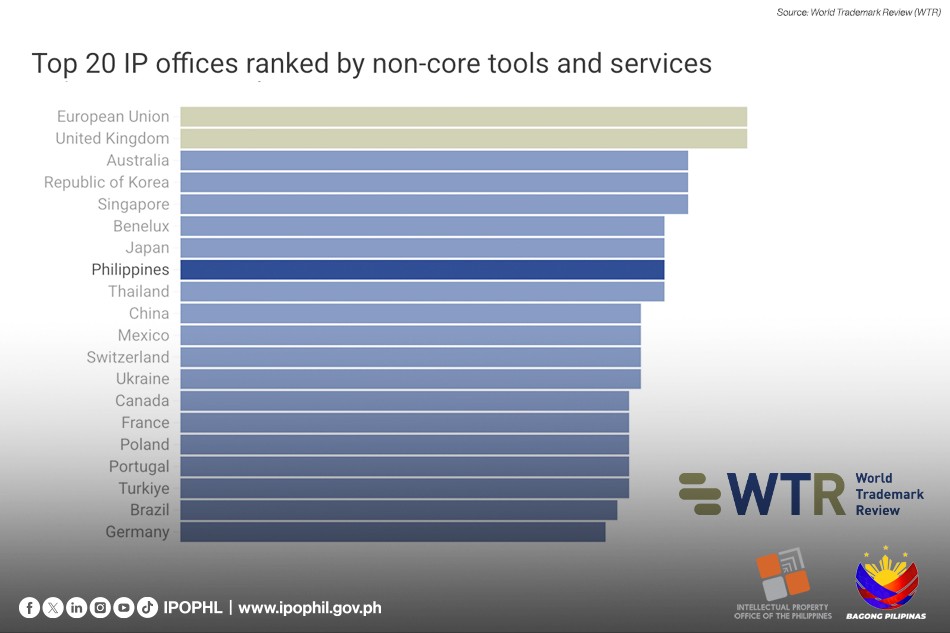
The Intellectual Property Office of the Philippines (IPOPHL) has been recognized as the third most innovative intellectual property (IP) office in the world, underscoring IPOPHL’s sustained investments in digital systems and institutional capacity-building.
Based on the World Trademark Review’s (WTR) 2026 IP Office Innovation Ranking, IPOPHL tied with the IP offices of Benelux, Japan and Thailand. Together, they trailed behind the IP offices of the European Union and the United Kingdom, which tied for first place, and Australia, the Republic of Korea and Singapore, which landed second place.
The 2026 results, which analyzed over 40 jurisdictions, show a dramatic rise for IPOPHL, which previously placed 9th in the 2022 ranking and 13th in the 2024 report.
The latest edition places IPOPHL second in Asia and ASEAN, with only six Asian offices and three ASEAN offices making the global top 20.
“IPOPHL’s strong position in the global ranking reflects its long-term strategy of investing in end-to-end online systems, digital filing and search platforms, and internal tools that improve examination quality and turnaround times. These are complemented by continuous capacity-building for examiners and staff, ensuring that the Office keeps pace with rapid developments in emerging technologies, evolving business models and the increasingly digital nature of IP transactions,” Acting Director General (ADG) Nathaniel S. Arevalo said.
The WTR is a London-based intelligence platform offering daily news, legal analysis and research on trademark law, brand strategy and global market trends.
WTR’s IP Office Innovation Ranking is a multi-year global assessment that looks at how IP offices are moving beyond basic registration functions by delivering value-added services to users. The assessment covers areas such as digital infrastructure, dispute resolution, support for small and medium enterprises, enforcement collaboration and public engagement.
For the 2026 edition, WTR placed stronger focus on the use of AI, recognizing its expanding role in trademark administration but distinguishes between AI tools designed for public use, such as search and filing systems, and those used internally to assist examiners and streamline workflows.
Future-ready with AI
ADG Arevalo shared that IPOPHL is in the works of integrating AI tools into its system to assist in search, examination, classification and appeals.
In November last year, IPOPHL also issued guidelines to strengthen patent examination quality and consistency to clarify rules for examiners and stakeholders when dealing with AI-related technology applications.
IPOPHL is also examining how AI tools can be legally and practically recognized in the creation of works, as well as their implications for copyright protection and enforcement.
“Looking ahead, IPOPHL is both shaping the framework for AI-generated works and harnessing AI within its own operations, positioning the Philippine IP system to be more efficient, adaptive and future-ready,” ADG Arevalo added.

