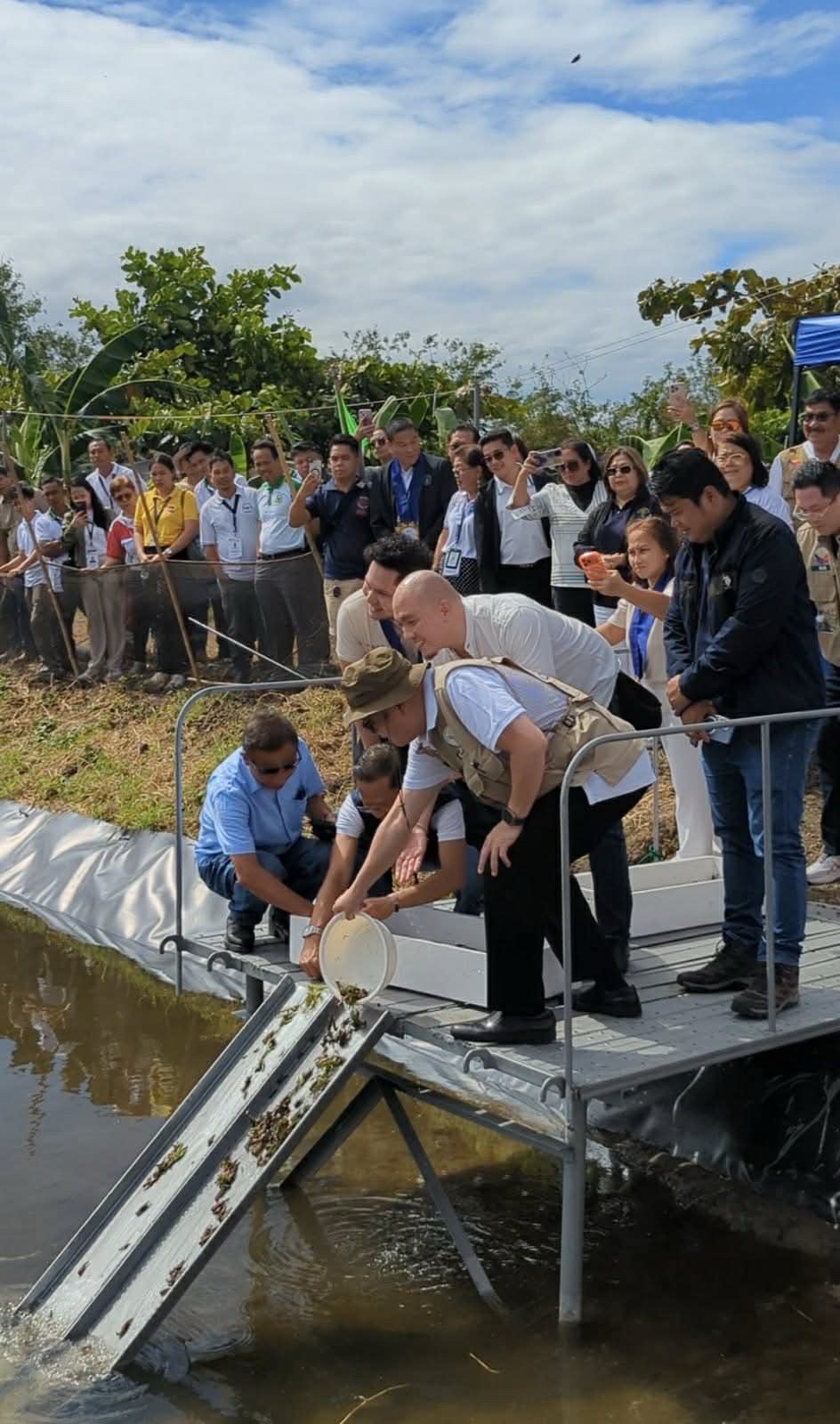
MUNOZ, Nueva Ecija—In a province known as the country’s main producer of rice, the Department of Agriculture is testing the commercial viability of a very different crop: the Australian redclaw crayfish.
The DA is hopeful that the high value species can help reshape local aquaculture.
Agriculture Secretary Francisco P. Tiu Laurel on Thursday led the ceremonial stocking of 14,000 craylings, launching an on-farm verification trial designed to determine if raising redclaw crayfish in Philippine freshwater ponds makes commercial sense.
“We want our farmers to grow profits, not just crops,” Tiu Laurel said. “With proper observance of good aquaculture practices and biosecurity measures, the culture of Redclaw crayfish offers huge potential that could sustainably transform fish farming in the Philippines.”, he added.
The project, rolled out by the DA–Bureau of Fisheries and Aquatic Resources (BFAR) with private-sector partners, marks a clear shift. This is aquaculture driven by science, markets, and controls—not just expansion for expansion’s sake.
That shift was formalized late last year with BFAR Administrative Circular No. 001, series of 2025, which sets the country’s first national rules for culturing Australian redclaw crayfish. Broodstock and craylings must come from certified local hatcheries or BFAR facilities, keeping biosecurity risks in check.
At the heart of the effort is BFAR’s prototype hatchery at the National Freshwater Fisheries Technology Center. Thirty female and 10 male breeders anchor the program, supported by 200 future breeders, producing up to 5,000 craylings per cycle over three to five cycles a year. Another 300 craylings are earmarked for tank-based trials.
In Nueva Ecija, the real-world test will run four to five months across four ponds. Two stocking densities—10 and 15 crayfish per square meter—will be tested. Survival, growth, feed efficiency, and returns will decide whether the species can thrive commercially.
If successful, BFAR will roll results into full technology demonstrations, packaging protocols for farmer training and wider adoption in suitable inland areas.
The project signals a careful, strategic approach. Redclaw crayfish fetch premium prices, but they also carry ecological and market risks. By emphasizing biosecurity, controlled trials, and private-sector partnership, the DA is signaling a new aquaculture playbook—value, sustainability, and discipline over rapid, unregulated growth.